Fall Protection certificate templates and badges
3 free designs. A set is one design as a badge, a landscape or a portrait certificate, or all three.
Free for up to 20 recipients a year
Clearance Section set
Badge · Landscape · Portrait
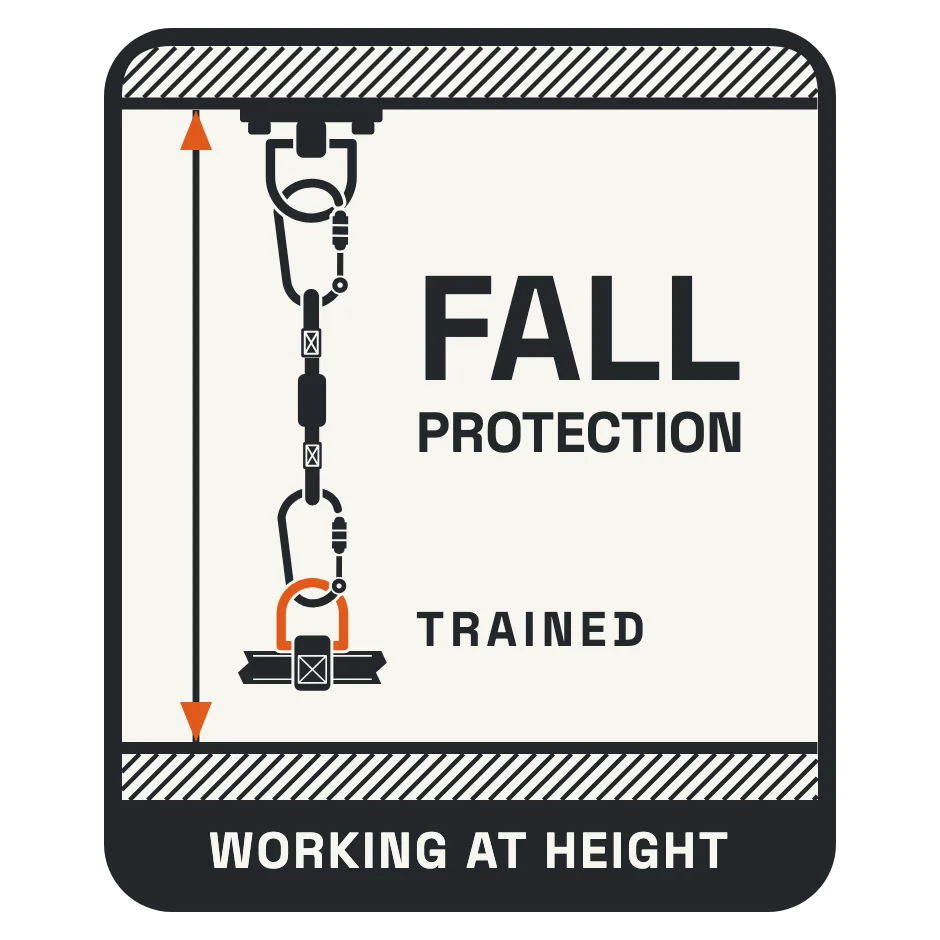
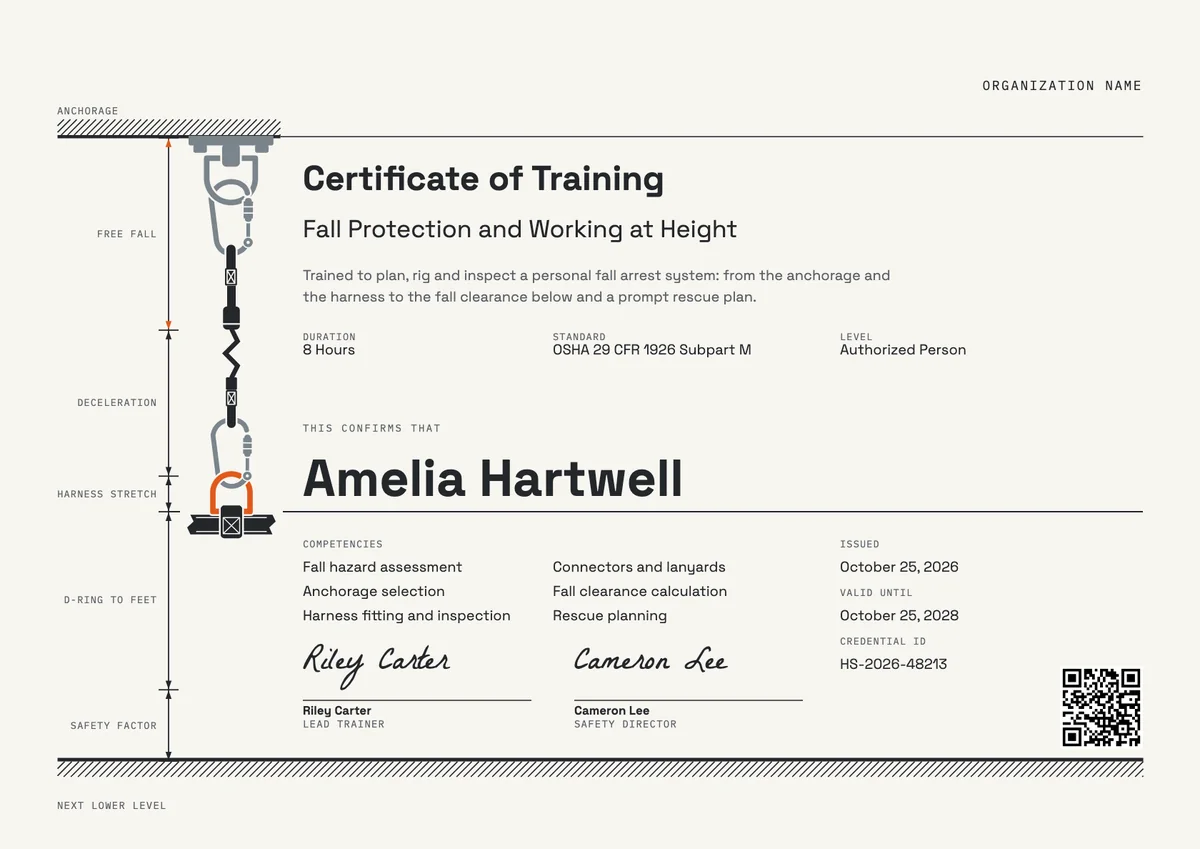
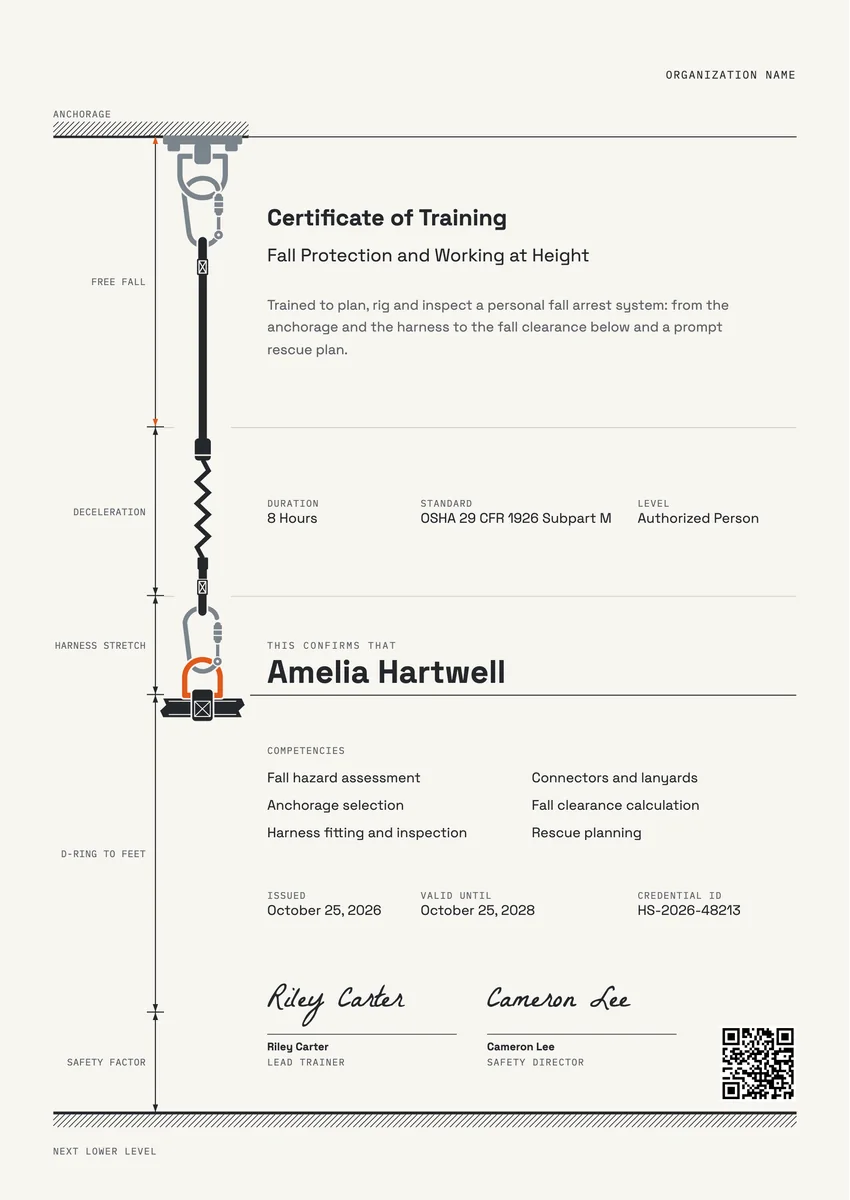
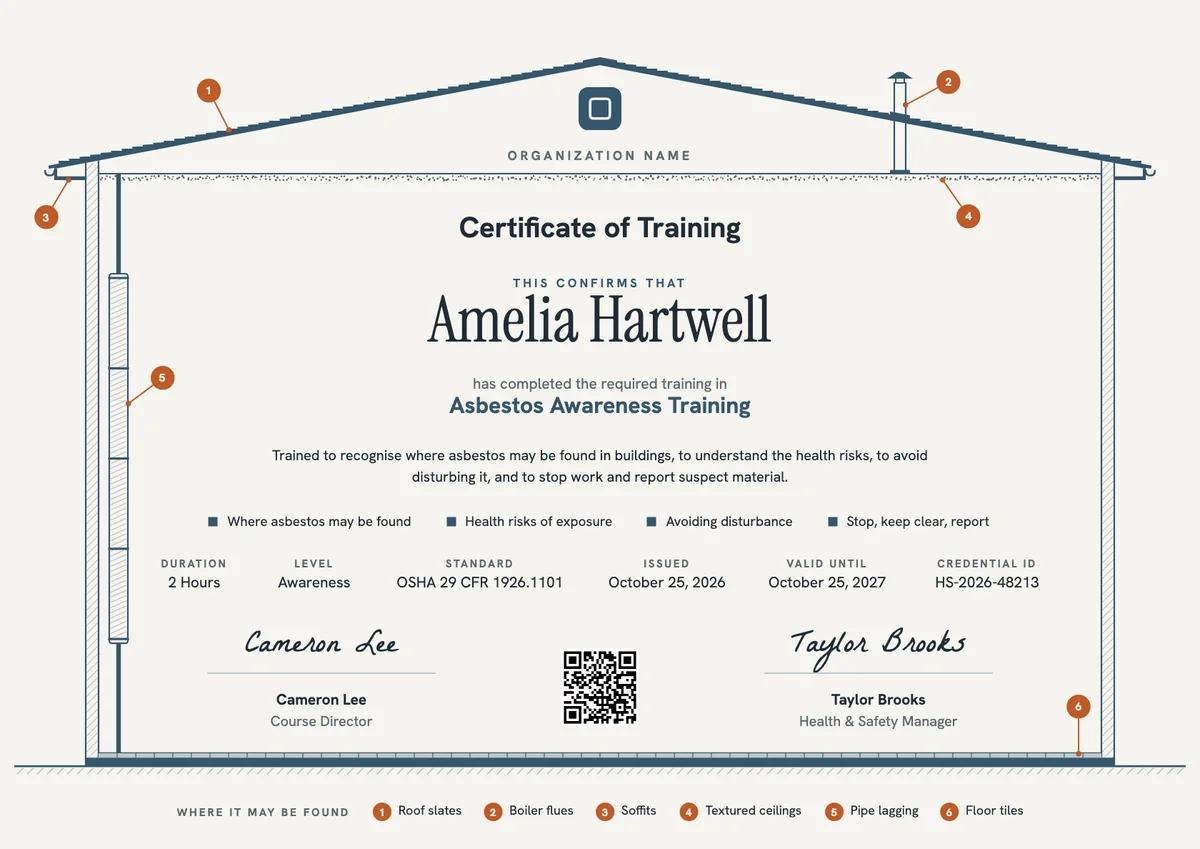
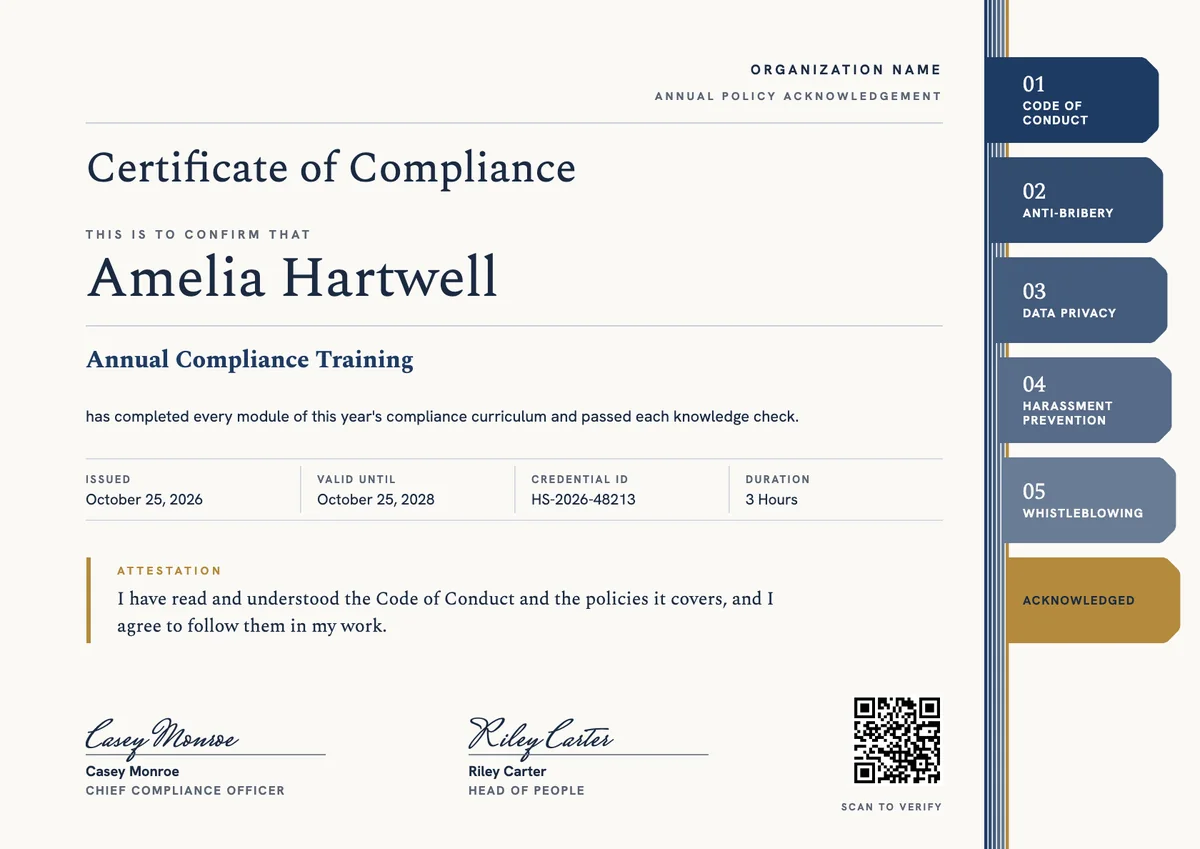
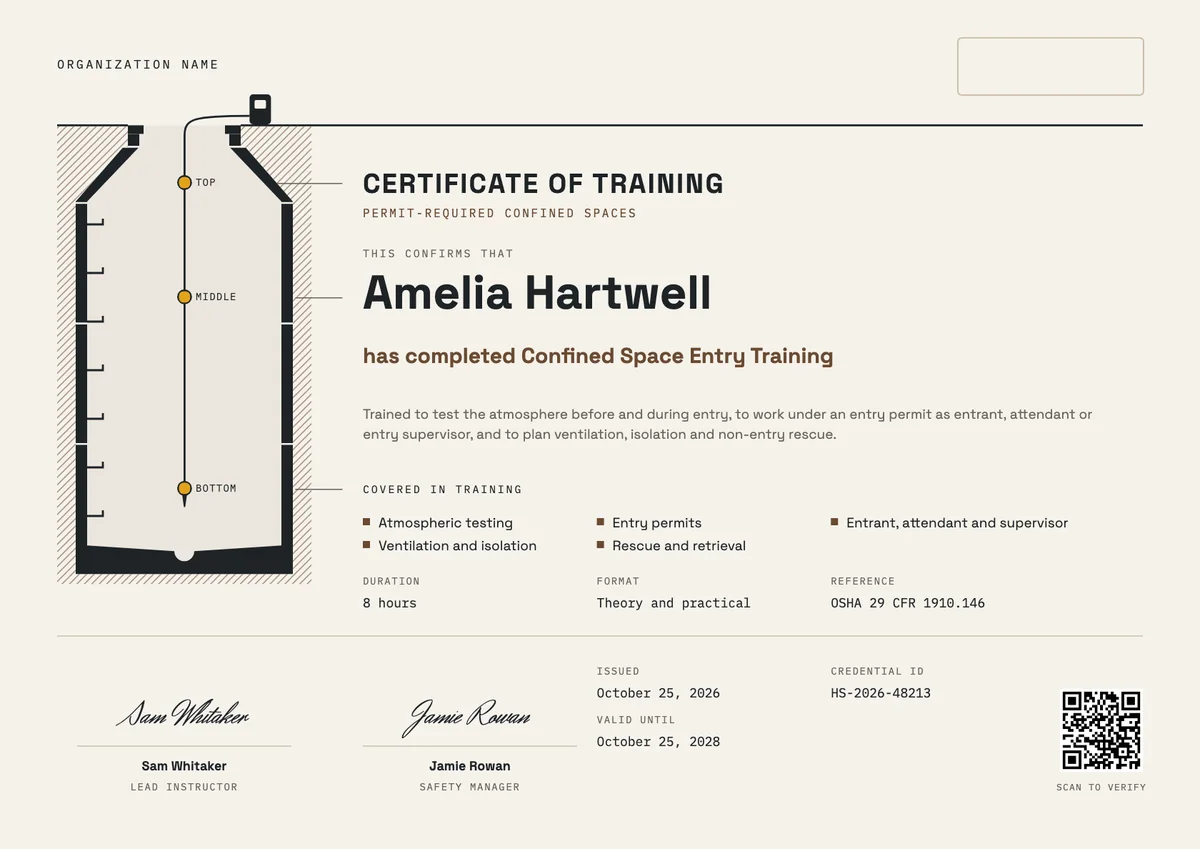
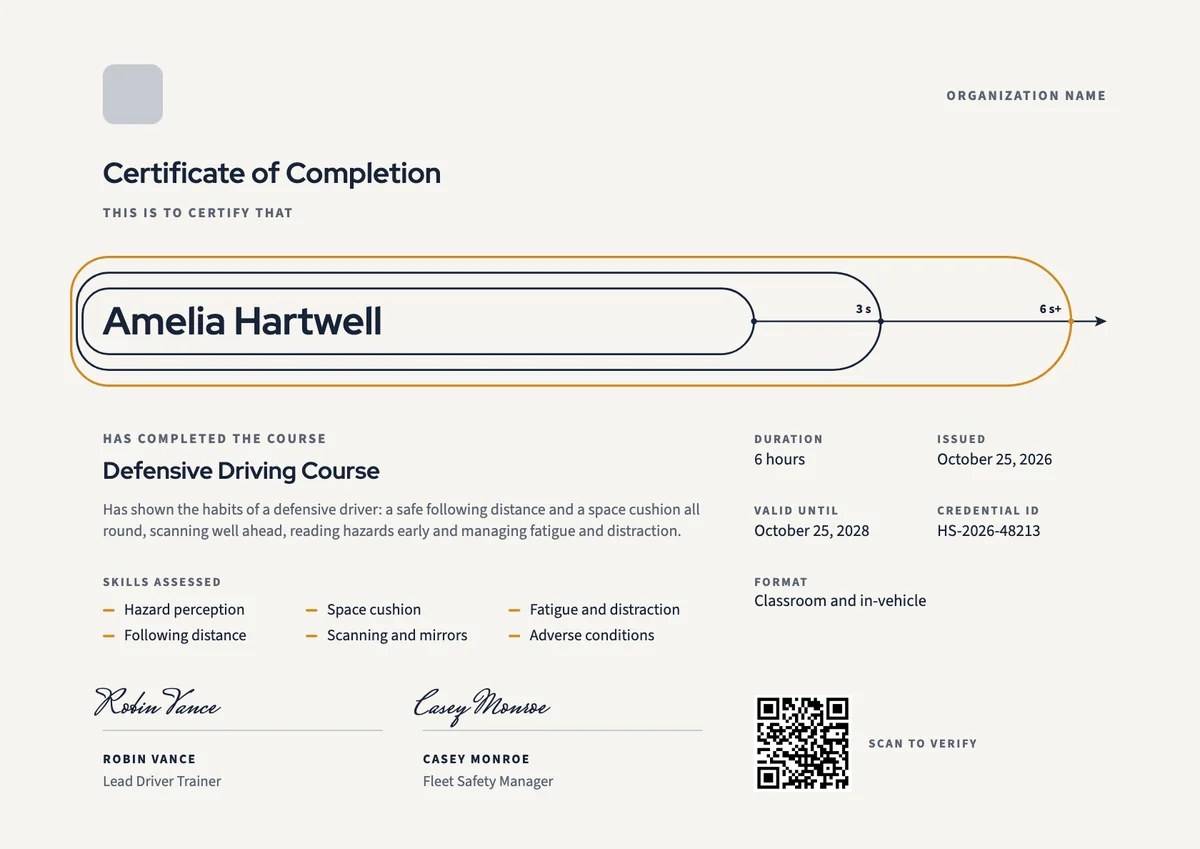
A fall protection certificate template gives a training provider or an employer a clear record that a worker has finished fall protection training. Roofing and steel contractors, scaffolding firms, utilities, telecom and wind companies give one to the people who work at an edge, on a roof or a tower, after the first course and after each refresher.
A good working at height certificate names the worker, the course and who ran it. It says in one sentence what the person can now do and lists the core topics: assessing fall hazards, choosing a suitable anchorage, fitting and inspecting a full-body harness, checking connectors and lanyards, working out the fall clearance below the work, and planning a prompt rescue. Add the duration, the issue date, a valid-until date and the trainer's signature. The certificate records training; it is not a licence or a permit to work.
The designs come as certificates in A4 and US Letter and as digital badges that workers can show on a profile.
Wording
What to write on a fall protection certificate
Use these lines as they are, or as a start for your own. Every template comes with wording you can change in the studio.
Wording for a fall protection training certificate
- “Has completed fall protection training and can assess a fall hazard, select an anchorage, fit and inspect a harness, and plan a prompt rescue.”
- “For completing training in the use, inspection and care of a personal fall arrest system.”
- “Has completed the annual fall protection refresher course.”
Wording for a working at height training certificate by role
- “Has completed working at height training for the role of authorized person and can use the fall protection systems chosen for the task.”
- “Has completed competent person training in fall protection and can inspect equipment, check anchorages and take a system out of service.”
- “Has completed fall rescue training and can carry out the site's rescue plan for a worker held by a fall arrest system.”
Short lines for the badge or the email
- “Fall protection trained. Inspect, connect, and check the clearance below.”
- “Trained to work at height, and trained to bring a colleague down safely.”
Why send it with Hyperstack
More than a PDF
Customize the template free. When it is ready, send it to everyone at once.
One design, every name
Upload a spreadsheet and Hyperstack makes a training certificate for each person on it, in one go.
Sent by email
Each recipient gets their own email and link. You see who opened it, downloaded it and shared it.
Anyone can verify it
The QR code opens a page that proves the certificate is real. Recipients add it to LinkedIn in one click.
FAQ
Questions, answered
Fall restraint keeps a worker from reaching the edge at all: the lanyard or line is short enough that the person cannot get to the point where a fall could start. Fall arrest lets a fall begin and then stops it, using a harness, a connecting device and an anchorage. Guardrails and covers come first where they are practical, then restraint, and arrest when the others cannot be used. A good course teaches the worker to tell which system a task needs.
It has to be strong enough to hold the forces of an arrested fall, sit where the worker's connection stays as close to overhead as possible, and be chosen or approved by someone qualified to judge it. Pipes, cable trays, light fittings and guardrails are not anchorages unless they have been rated for it. The required strength depends on the rules and standards that apply to your site, so the training should name the ones your workers use.
Look along all the webbing for cuts, burns, fraying, chemical damage and broken or pulled stitching, including the sewn keeper at the dorsal D-ring. Check the D-rings, buckles and adjusters for cracks, rust, sharp edges and distortion, and make sure the labels can still be read. If a fall indicator has deployed or the harness has held a fall, it comes out of service. A competent person also inspects it at set intervals, in addition to the user's check.
Fall clearance is the distance needed below the worker so that a fall is stopped before the person hits the next lower level or an obstruction. It adds up the free fall, the deceleration distance as the energy absorber opens, the stretch of the harness, the distance from the D-ring to the worker's feet and a safety margin. The figures come from the equipment maker's instructions for the exact lanyard or lifeline used, so training teaches how to read them, not to guess.
A worker held by a harness after a fall cannot simply wait for help: hanging still in a harness can quickly become dangerous, so the person has to be reached and brought down promptly. The rescue plan says who will do it, with what equipment, and how they will reach the worker from the anchorage or from below. It is agreed and practised before the work starts. Calling emergency services alone is rarely fast enough.
An authorized person is a worker trained to use the fall protection equipment the employer has chosen for the task: to inspect it before use, put it on, connect it and work safely with it. A competent person has wider knowledge and the authority to act: they can identify fall hazards, inspect equipment and anchorages at set intervals, and take a system out of service. Many courses are written for one of the two roles, so name the role on the certificate.
Your next cohort deserves better than a PDF
Set up in minutes, send your first credentials today, and only pay once you grow past 20 recipients a year.
Or open a live sample credential