Defensive Driving certificate templates and badges
3 free designs. A set is one design as a badge, a landscape or a portrait certificate, or all three.
Free for up to 20 recipients a year
Space Cushion set
Badge · Landscape · Portrait
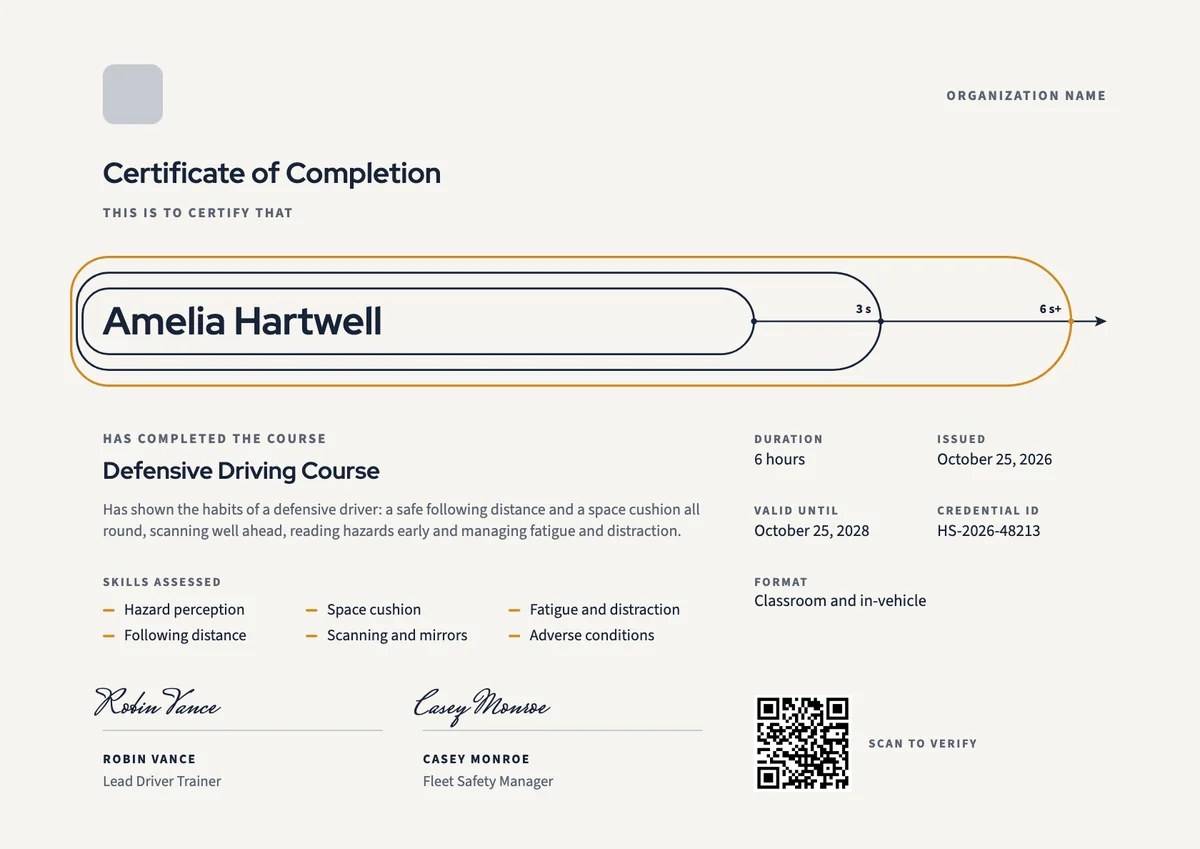
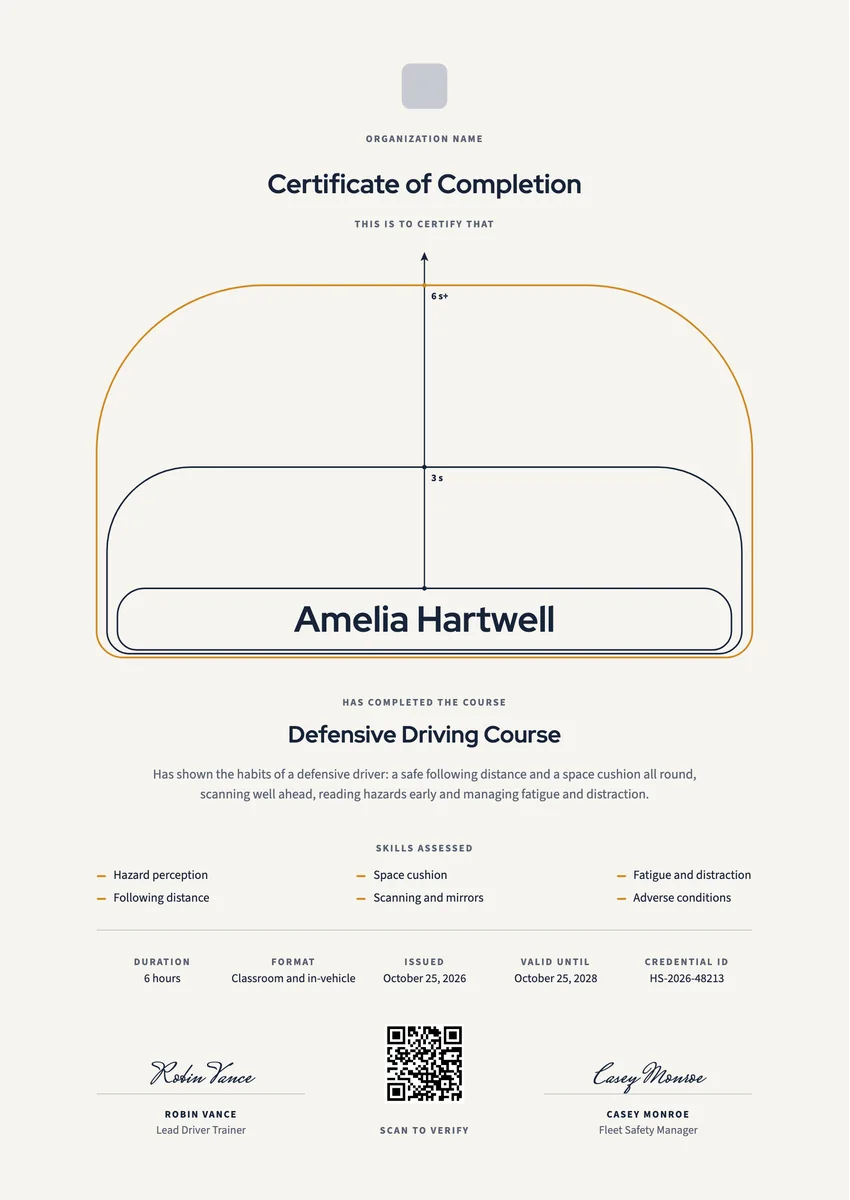
A defensive driving certificate template gives you a ready record for the drivers who finish your course: company and fleet drivers, field staff, people on an employer's road-risk programme, and adults who choose to sharpen their habits. Fleet-safety trainers, driver-training companies, road-safety organisations and in-house HSE teams hand it over at the end of the classroom or in-vehicle session.
A good one says more than the name. It names the course, the habits the driver showed (following distance, a cushion of space, early hazard reading, managing fatigue and distraction), how long the training ran, the trainer's signature, the issue date and, when you expect a refresher, a valid-until date.
The designs here come as certificates in A4 and US Letter and as digital badges. A printed certificate for defensive driving goes in the driver's training file, and the verified digital copy can be shared online.
Wording
What to write on a defensive driving certificate
Use these lines as they are, or as a start for your own. Every template comes with wording you can change in the studio.
Wording for a defensive driving course certificate
- “Has completed the defensive driving course and shown a safe following distance, good observation and early hazard perception.”
- “For completing six hours of defensive driving training, in the classroom and in the vehicle.”
- “In recognition of safe, alert and courteous driving habits assessed by our driver trainers.”
Defensive driving award certificate wording for fleet drivers
- “Has completed the company's defensive driving programme for fleet and pool vehicle drivers.”
- “Assessed on the road for space management, mirror use, speed for conditions and fatigue awareness.”
- “Refresher training completed as part of our driver risk management programme.”
Short lines for the badge or the email
- “Defensive driving: completed.”
- “Space ahead, eyes up, home safe.”
Why send it with Hyperstack
More than a PDF
Customize the template free. When it is ready, send it to everyone at once.
One design, every name
Upload a spreadsheet and Hyperstack makes a certificate of completion for each person on it, in one go.
Sent by email
Each recipient gets their own email and link. You see who opened it, downloaded it and shared it.
Anyone can verify it
The QR code opens a page that proves the certificate is real. Recipients add it to LinkedIn in one click.
FAQ
Questions, answered
Years behind the wheel build confidence, but also habits that drift: following too close, glancing at a phone, driving tired at the end of a long shift. A defensive driving course resets those habits and teaches drivers to plan for the mistakes of other road users, not only their own.
Usually hazard perception, safe following distance, keeping a space cushion round the vehicle, scanning and mirror use, speed for the conditions, fatigue and distraction, and driving in rain, fog or darkness. Many fleet programmes add an in-vehicle drive with a trainer who assesses these habits on real roads.
Yes. Classroom and online courses cover the theory, while an in-vehicle session shows the habits on real roads with a trainer watching. Writing the format and the hours on the certificate tells a fleet manager exactly what the driver has done, and whether a practical drive is still needed.
There is no single rule; it depends on the employer's driving policy and the risk of the work. Many organisations set a refresher every few years, and sooner after an incident, a change of vehicle type or a long break from driving. Put that date on the certificate as the valid-until date.
Anyone who drives for work, not only the people with a company vehicle: van and truck drivers, sales and field staff, people who use pool cars, and staff who drive their own car on business. Employers often start with those who drive the most miles or have had a recent incident.
They are time gaps. Three seconds is a common minimum following distance in good conditions, and the gap should be at least doubled on wet or icy roads or in poor visibility. The design puts the driver's name where the vehicle would be, inside that cushion of space.
More certificate templates
Your next cohort deserves better than a PDF
Set up in minutes, send your first credentials today, and only pay once you grow past 20 recipients a year.
Or open a live sample credential