Electrical Safety certificate templates and badges
3 free designs. A set is one design as a badge, a landscape or a portrait certificate, or all three.
Free for up to 20 recipients a year
Locked Disconnect set
Badge · Landscape · Portrait
An electrical safety training certificate records that a worker has completed a course on working safely on or near electrical equipment. Employers, electrical contractors, facilities teams and training centres give one to electricians, maintenance technicians, engineers and machine operators after their first course and again after each refresher, usually with a date by which the training should be repeated.
A good one names the course and lists what it covered: shock and arc flash hazards, approach boundaries, electrical PPE, lockout/tagout and safe work practices. It shows the duration, the standard the course follows, the completion date and a signature from the trainer or the training manager. It is a record of training; deciding who is qualified for a task stays with the employer.
The electrical safety certificate templates here come as certificates in A4 and US Letter and as badges, so a worker can keep a printed copy in the training file and share the same credential online.
Wording
What to write on a electrical safety certificate
Use these lines as they are, or as a start for your own. Every template comes with wording you can change in the studio.
Wording for an electrical safety training certificate
- “For completing electrical safety training for work on and near energised equipment.”
- “Has completed training in shock and arc flash hazards, approach boundaries, electrical PPE and lockout/tagout.”
- “Trained to recognise electrical hazards and to establish an electrically safe work condition before work begins.”
Wording for an arc flash certificate or a lockout/tagout refresher
- “For completing arc flash awareness training, including the arc flash boundary and the selection of arc-rated PPE.”
- “Has completed lockout/tagout training: isolate, lock, tag and test before touch.”
- “For completing refresher training in electrical safe work practices.”
Short lines for the badge or the email
- “Isolate. Lock. Prove it dead.”
- “Electrical safety training complete.”
Why send it with Hyperstack
More than a PDF
Customize the template free. When it is ready, send it to everyone at once.
One design, every name
Upload a spreadsheet and Hyperstack makes a training certificate for each person on it, in one go.
Sent by email
Each recipient gets their own email and link. You see who opened it, downloaded it and shared it.
Anyone can verify it
The QR code opens a page that proves the certificate is real. Recipients add it to LinkedIn in one click.
FAQ
Questions, answered
No. Under OSHA rules and NFPA 70E, the employer decides whether a person is qualified for a task, based on their training and the skills they have shown on that equipment. The certificate is evidence of the training and belongs in that record, but it does not qualify anyone on its own.
NFPA 70E asks for retraining at least every three years, and sooner when supervision or an annual inspection shows that someone is not following safe work practices, or when new equipment or changed procedures come in. Many employers choose a shorter cycle and put that date on the certificate as the valid-until date.
Lockout/tagout training covers the control of every kind of hazardous energy during servicing and maintenance: electrical, mechanical, hydraulic, pneumatic and thermal. Electrical safety training goes deeper into the electrical hazard: shock and arc flash, approach boundaries, PPE and how to create an electrically safe work condition, of which lockout is one step. When a course covers both, list both on the certificate.
It is the state in which the conductors and circuit parts to be worked on are disconnected from every source, locked and tagged, tested to confirm there is no voltage, and grounded where needed. The order matters: isolate, lock, then prove it dead before anyone touches it.
Yes, at their own level. OSHA rules and NFPA 70E expect unqualified workers, such as operators, cleaners or painters who work near electrical equipment, to be trained in the safe practices that protect them, like keeping clear of open panels and respecting locks and tags. Their certificate should name an awareness course, not the fuller course given to people who work on the equipment.
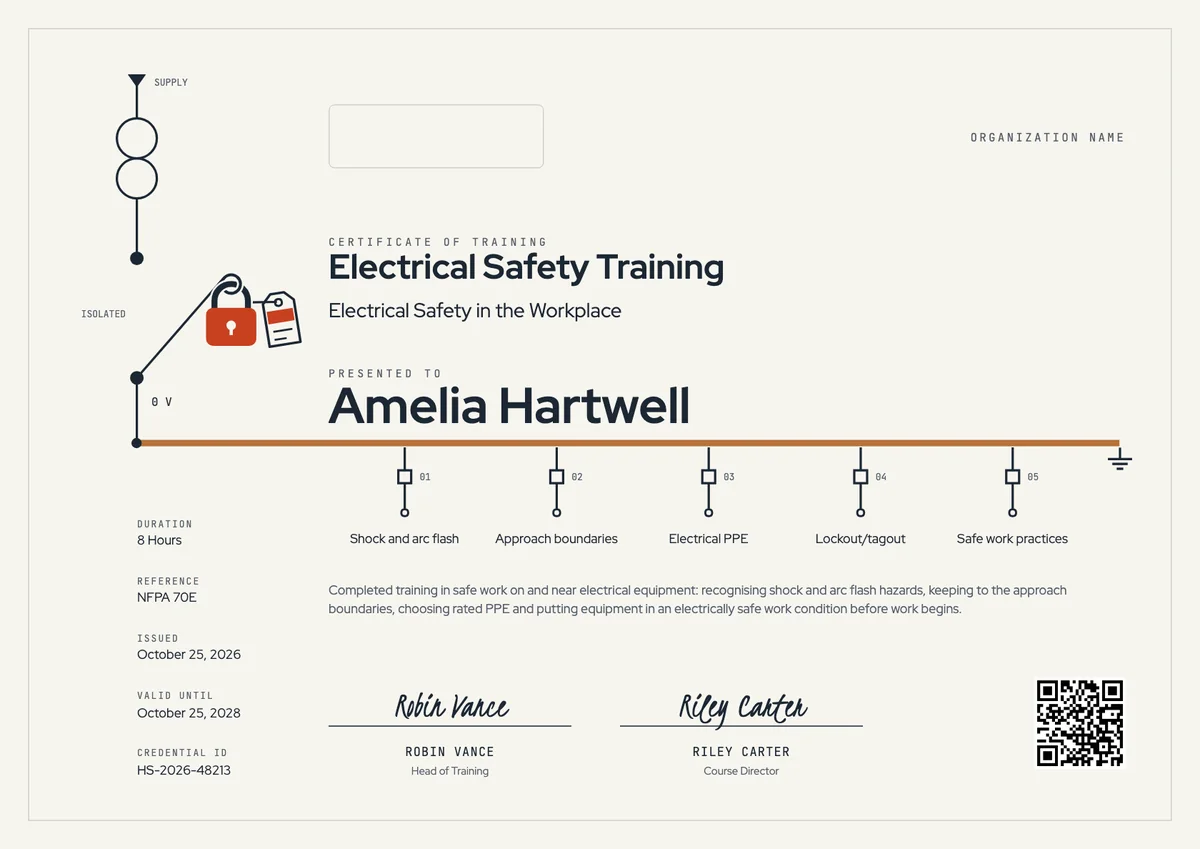
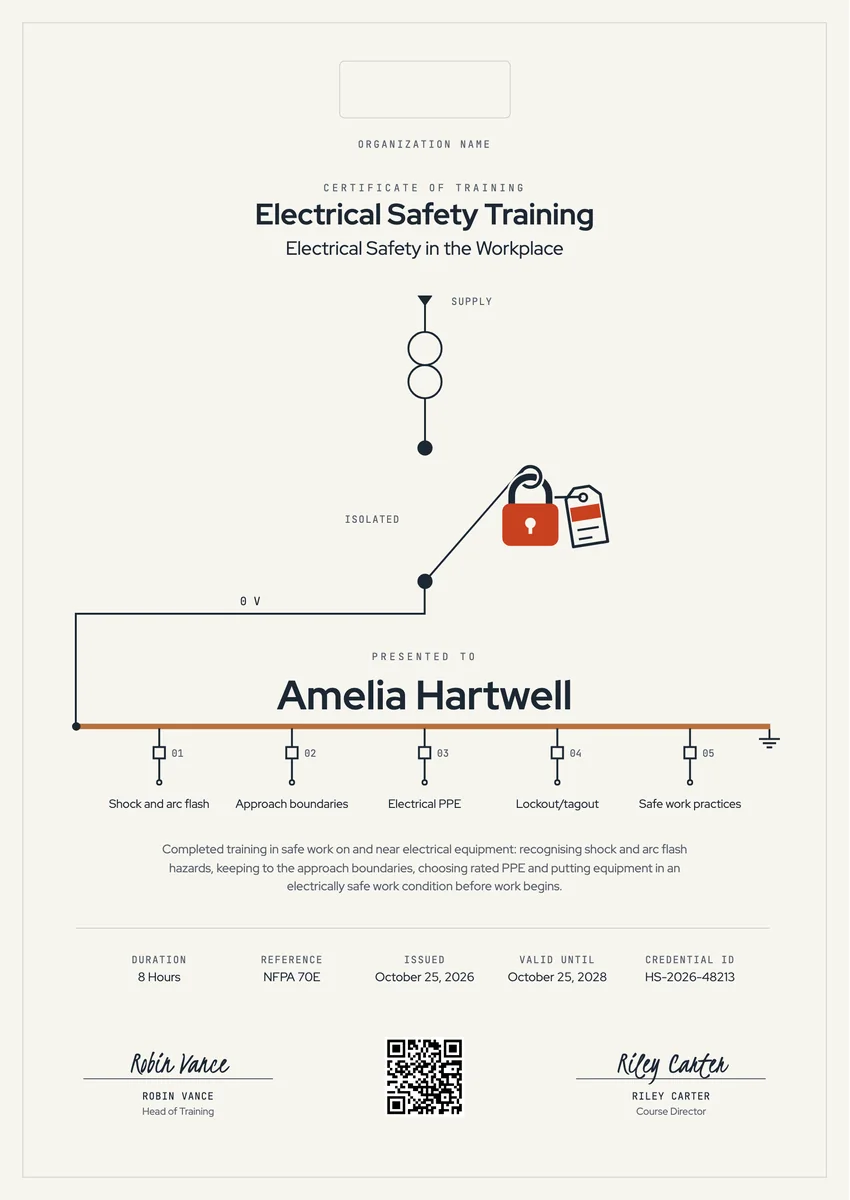
The drawing is a single-line diagram of a circuit made safe for work: the disconnect is open, a personal padlock and a danger tag hold it open, and the line after it reads 0 V. It shows the order the course teaches, isolate, lock and prove dead, without the usual lightning bolt.
Your next cohort deserves better than a PDF
Set up in minutes, send your first credentials today, and only pay once you grow past 20 recipients a year.
Or open a live sample credential