Bloodborne Pathogens certificate templates and badges
3 free designs. A set is one design as a badge, a landscape or a portrait certificate, or all three.
Free for up to 20 recipients a year
Infection Chain set
Badge · Landscape · Portrait
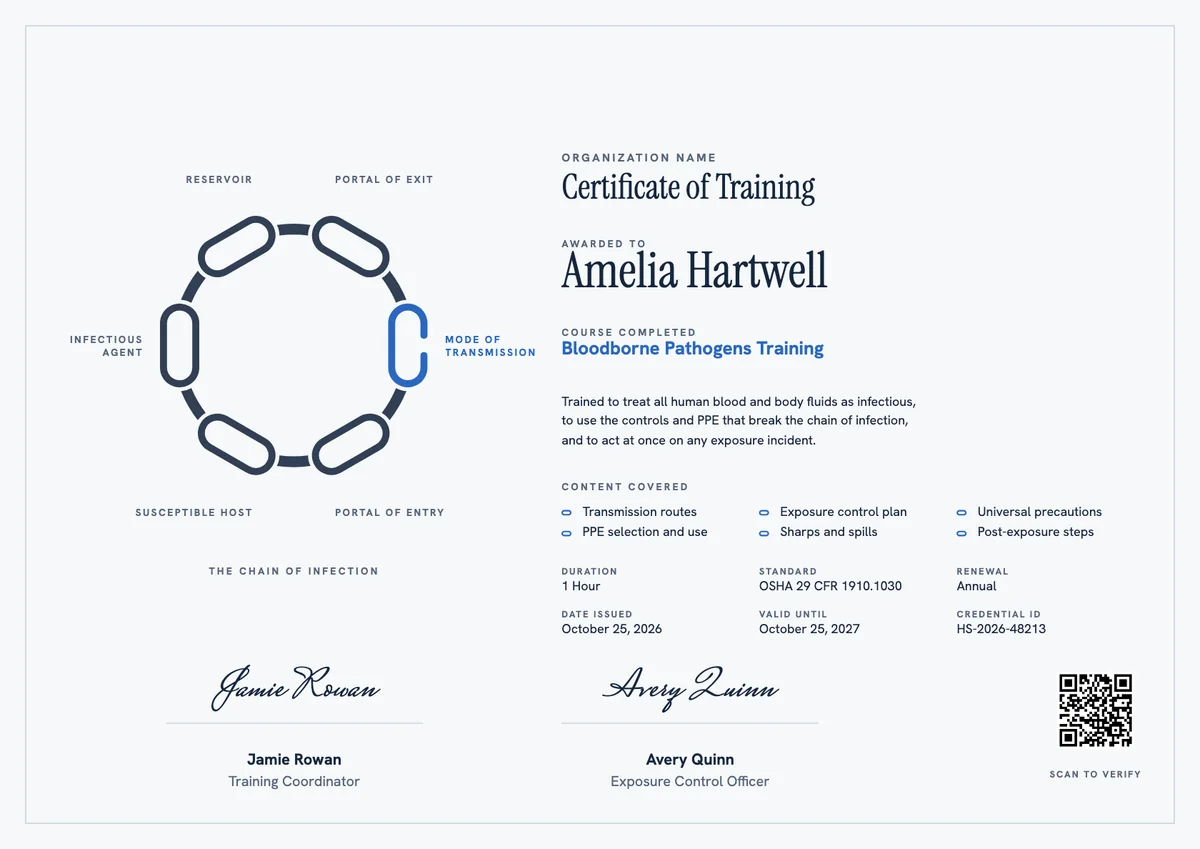
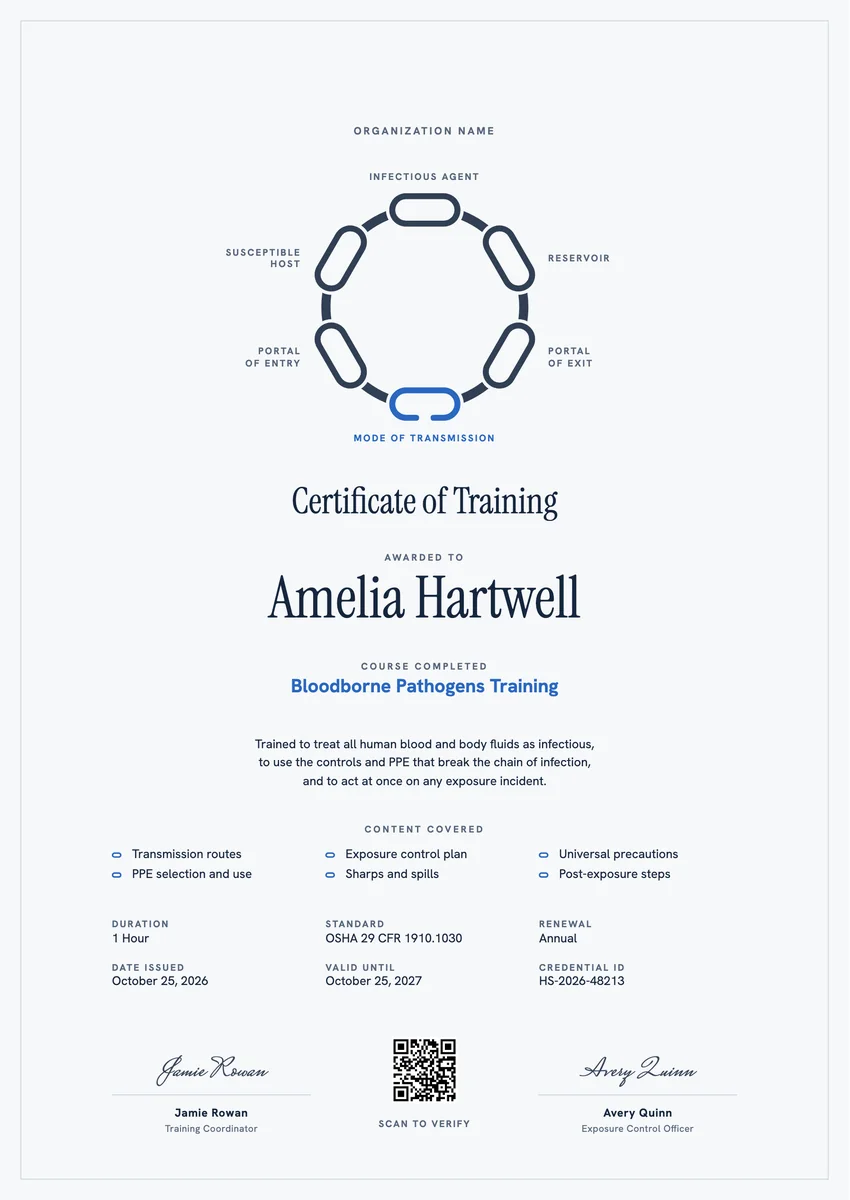
A bloodborne pathogens certificate template gives a training provider or employer a clean record for staff who may meet blood or other potentially infectious materials at work: nurses and dental teams, lab and phlebotomy staff, first responders, custodians, school nurses and body art studios. A bloodborne pathogens course certificate is handed out when the session ends, at hire and again at each annual refresher.
A useful bloodborne pathogens training certificate names the learner and the course, lists what the session covered, such as transmission routes, the exposure control plan, PPE and the steps after an exposure incident, and shows the date issued, the date the next session is due, a credential ID and the trainer's signature. The designs come as certificates in A4 and US Letter sizes and as digital badges, and each one can be verified online by scanning its QR code.
Wording
What to write on a bloodborne pathogens certificate
Use these lines as they are, or as a start for your own. Every template comes with wording you can change in the studio.
Bloodborne pathogens training certificate wording
- “Has completed bloodborne pathogens training, including transmission routes, the exposure control plan and the use of personal protective equipment.”
- “Trained to treat all human blood and body fluids as infectious and to follow the site's exposure control plan.”
- “For completing the bloodborne pathogens session for staff with occupational exposure to blood.”
Wording for an annual bloodborne pathogens refresher
- “For completing this year's bloodborne pathogens refresher and reviewing the updated exposure control plan.”
- “Annual refresher completed: sharps safety, spill cleanup and post-exposure steps reviewed.”
- “Refresher training completed; next session due by the date shown.”
Short lines for a bloodborne pathogens badge
- “Bloodborne pathogens trained.”
- “Break the chain: trained in exposure control.”
- “Annual bloodborne pathogens training complete.”
Why send it with Hyperstack
More than a PDF
Customize the template free. When it is ready, send it to everyone at once.
One design, every name
Upload a spreadsheet and Hyperstack makes a training certificate for each person on it, in one go.
Sent by email
Each recipient gets their own email and link. You see who opened it, downloaded it and shared it.
Anyone can verify it
The QR code opens a page that proves the certificate is real. Recipients add it to LinkedIn in one click.
FAQ
Questions, answered
Any role where contact with blood or other potentially infectious materials can be expected as part of the job. Common examples are nursing and medical staff, dental teams, lab and phlebotomy staff, paramedics and police, housekeeping and custodial staff, school nurses, tattoo and piercing artists, and employees named as first aid responders. An employer's exposure control plan normally lists the job roles at its site.
Usually not. Employers commonly repeat it every year and when tasks or procedures change, so the record shows a date issued and the date by which the next session is due. Many US employers plan this around the OSHA bloodborne pathogens standard. Check the rules that apply to your own workplace and country.
No. The certificate records that a named person completed your course on a given date. Whether the course content satisfies the rules for your sector and country is for the training provider or employer to confirm. If your course follows a named standard, you can enter it in the details field.
List what your session actually taught. Typical items are how pathogens such as hepatitis B, hepatitis C and HIV are spread at work, the exposure control plan, universal precautions, choosing and removing PPE, sharps handling, spill cleanup and the steps to follow after an exposure incident.
It helps. The trainer who ran the session signs as the instructor, and many sites add the person who keeps the exposure control plan, such as the infection prevention lead or the safety officer. The second signature ties the training to the site's own plan.
The chain of infection is a model taught in infection control, with six stages: infectious agent, reservoir, portal of exit, mode of transmission, portal of entry and susceptible host. The model teaches that removing one link interrupts the chain. The design opens the transmission link, the stage where gloves, sharps safety and cleanup do their work.
Your next cohort deserves better than a PDF
Set up in minutes, send your first credentials today, and only pay once you grow past 20 recipients a year.
Or open a live sample credential