
There is a moment in every technological shift when a system becomes self-sustaining. It stops depending on human explanations or institutional prestige to validate its worth. It becomes credible on its own. It becomes a reputation engine rather than a reputation borrower. That tipping point is the Reputation Singularity.
Digital credentials are moving toward that moment faster than most institutions realize.
For decades, a credential was only as strong as the name printed on it. Universities and training providers carried the reputation. The certificate simply inherited it.
Today, that hierarchy is being inverted. As verification infrastructure matures and credentials become machine readable, the credential begins to influence reputation dynamics instead of being shaped by them.
We are entering a phase where a digital credential is not just a receipt. It is a functional identity object. It proves, signals, travels, composes, and strengthens itself through network effects. And eventually, it stands independently in the hiring ecosystem, carrying its own credibility.
That is what we now call the Reputation Singularity.
This shift has profound implications for learners, employers, and universities. To understand its impact, we need to examine what is changing, how we got here, and what happens when credentials start crediting themselves.
The Old Reputation Model: Institutions Spoke, Credentials Echoed
Traditionally, recognition flowed in a single direction.
Institutions built trust through history, research, and academic rigor.
Degrees reflected that trust.
Employers accepted the degree because they accepted the institution.
The underlying logic was simple. If a university was credible, everything it issued must also be credible. The credential itself played no active role. It was a silent carrier of reputation.
This worked when careers were stable, industries changed slowly, and employers had time to decipher transcripts. It worked when a single degree could support a lifetime of professional identity.
That world no longer matches the realities of the modern workforce.
Industries evolve quickly. Skills expire quickly. Hiring is automated. Talent is global. Employers now evaluate capability based on clarity, not pedigree. The credential must now carry proof, precision, and trustworthy data, not just a logo.
The Inflection Point: Verification is now Infrastructure
A reputation singularity only forms when trust shifts from the issuing institution to the verification infrastructure. This shift depends on three foundational elements.
1. Machine readable skills
Digital credentials with structured metadata can be interpreted instantly by hiring systems and AI matching engines. They move from static documents to active data objects. The credential no longer relies on human interpretation.
2. Independent verification
When a credential can verify itself through secure, globally accessible validation, employers do not need to contact the issuer. Trust begins to live inside the infrastructure rather than the institution.
3. Interoperability across ecosystems
A credential that travels across jurisdictions, digital wallets, job boards, and learning platforms builds a reputation of its own. It becomes a mobility asset.
Once these elements stabilize, the credential begins to stand independently as a trustable artifact. This is the early stage of the singularity.
Quick Fix for Institutions
If your university is exploring digital credentials but unsure where to begin, start with a small, high-clarity pilot. A single course is often enough to show value to faculty, leadership, and learners. If you want a practical framework that aligns with academic workflows, Hyperstack can walk you through it with minimal friction.
The New Reputation Model: Credentials as Autonomous Reputation Units
Imagine a credential that does not wait for someone to validate it. A credential that can demonstrate performance, reveal skill depth, and update itself as the learner grows. A credential that integrates into hiring systems without the learner manually presenting anything.
This is not speculative. It is the direction in which the ecosystem is already moving.
A credential in the singularity behaves like an autonomous reputation unit. It can:
- carry verifiable skill evidence
- signal competency depth, not just completion
- integrate with applicant tracking systems
- reveal related pathways and forward-learning opportunities
- gain employer recognition through repeated verification
- strengthen its own network value over time
When thousands of these exist across the ecosystem, they begin generating their own individual reputation loops. The credential becomes an active identity object rather than a passive certificate.
The Mindshare Loop: How Signals Reinforce Themselves
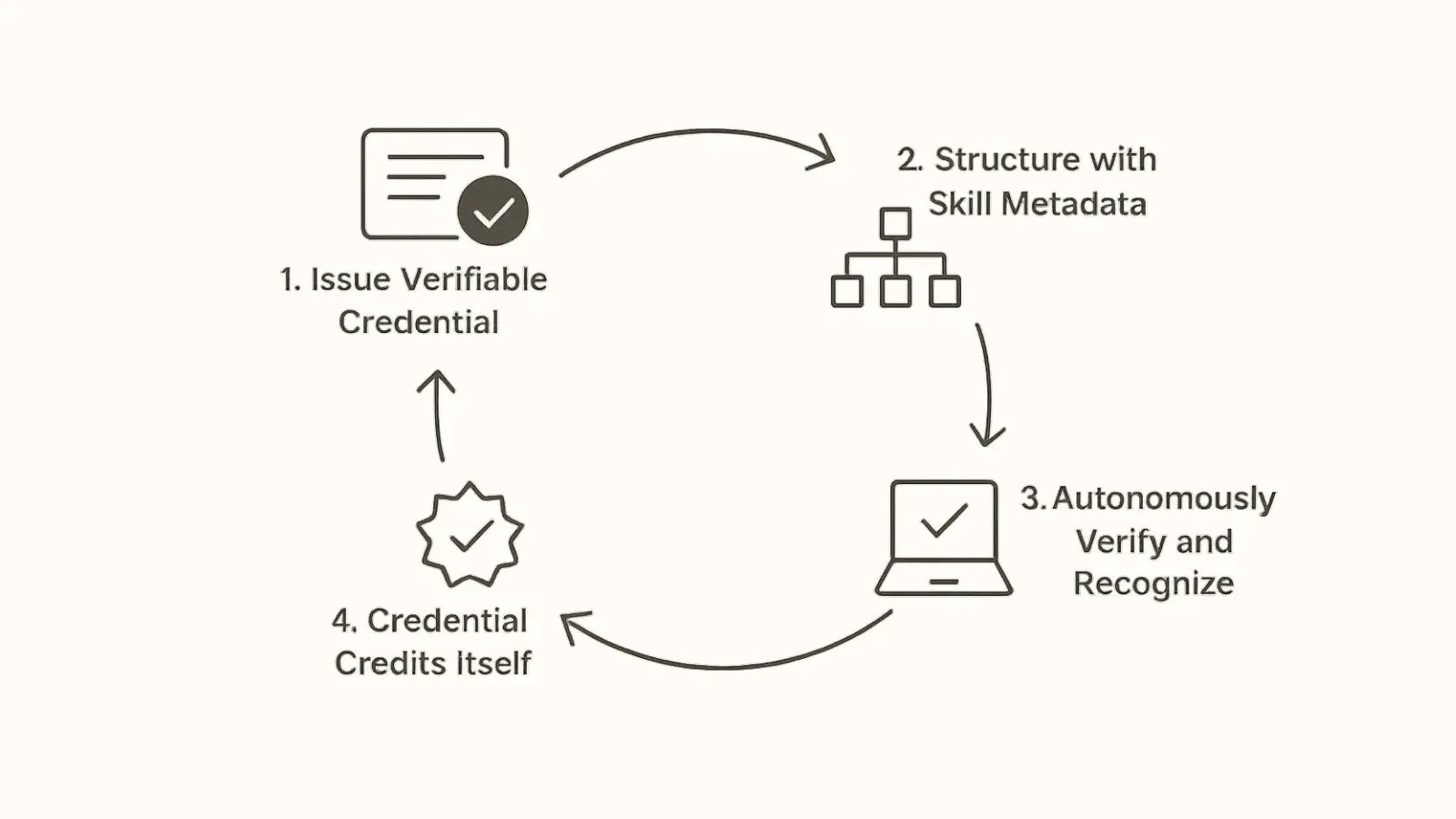
Every mature reputation system develops a mindshare loop. A credential is issued. It performs well. Employers trust similar signals. Learners share them more frequently. Institutions notice and improve credential quality. The system grows exponentially stronger with every cycle.
This loop is how a credential begins generating reputation independently of institutional branding. When a credential becomes recognizable and consistently reliable, it enters public awareness. It becomes part of how employers understand capability.
To see this concept explored in depth, connect it to our earlier piece on the topic:
Mindshare Loop - How Digital Credentials Create Self-Sustaining Growth
The conclusion is clear. A credential with strong metadata, verification, and clarity enters the mindshare loop more quickly. Once it does, its reputation compounds without additional effort from the institution.
Why This Matters for Universities
Universities often treat digital credentials as add-ons. Enhancements rather than strategic assets. But in the singularity era, credentials become central to institutional relevance.
1. The institution’s credibility travels farther
High-quality credentials circulate through global hiring systems. Each verification carries the institution’s identity into new markets without additional outreach.
2. Skills become the modern language of academic value
Learners and employers evaluate programs based on the clarity of outcomes. Programs with strong skill signals outperform programs with strong promotional material.
3. Real-time visibility replaces static reputation cycles
Credential performance offers immediate, ongoing feedback. The institution’s visibility grows as credentials circulate.
4. Institutional reputation becomes dynamic
Reputation evolves continuously based on the consistency and clarity of issued credentials. It becomes a living metric.
Universities that lean into this shift gain a durable competitive advantage.
Why This Matters for Learners
For learners, the singularity represents a shift in power. They no longer rely solely on their institutions to validate their capability.
1. Reputation becomes portable
Learners carry verified skill identity into any geography or industry without re-proving themselves.
2. Automated hiring systems understand them
AI matching engines can read and interpret their credentials directly, improving fairness and filtering accuracy.
3. Nontraditional learners gain equal visibility
Those outside elite institutions finally gain signals that speak clearly to employers.
4. Skill profiles compound over time
Each new credential strengthens earlier ones. The learner’s capability becomes a continuously improving asset.
This levels the playing field in a way traditional transcripts never could.
Why This Matters for Employers
Employers gain clarity, consistency, and confidence.
Less noise in screening
Structured skill data removes guesswork and reduces unnecessary interviews.
Better evaluation accuracy
Credentials reveal the depth of skill, not just the category of knowledge.
Cross-border mobility
Instantly verifiable credentials reduce friction in global hiring and remote work arrangements.
As credential ecosystems mature, employers gain a hiring advantage that legacy systems could never provide.
If You Are Planning for the Future of Academic Reputation
This is the right moment to explore how your institution’s credentials can evolve into high-signal, high-trust artifacts. If you want support designing metadata, structuring verifiable achievements, or aligning with hiring systems, we can help you shape a strategy that fits your academic and operational environment.
How We Get to the Singularity
The path unfolds in five stages.
Phase 1: Issuance
Digital credentials mirror traditional certificates.
Phase 2: Verification
Credentials gain secure validation that does not require manual checks.
Phase 3: Interpretation
Hiring systems integrate metadata into screening workflows.
Phase 4: Recognition
Employers trust the verification layer enough to rely on the credential.
Phase 5: Autonomy
Credentials become self-validating reputation entities.
Most academic institutions are between Phase 2 and Phase 3. Forward-looking ecosystems are entering Phase 4. And Phase 5 arrives when verification and interpretation become universally accepted.
Closing Perspective
The Reputation Singularity is not about replacing institutions. It is about elevating capability. It is about giving skills a voice of their own. It is about letting credentials evolve from static, fragile documents into dynamic trust signals that strengthen every time they are used.
The future belongs to clear signals.
The future belongs to proof.
And those proofs are learning to represent themselves.
Are you ready to future-proof your credentialing system? Schedule a free demo today!
Frequently asked questions
It is the point where digital credentials become credible on their own. Instead of depending entirely on the issuing institution’s prestige, the credential gains trust through verification infrastructure, metadata clarity, and consistent performance across hiring ecosystems.
Universities gain a reputation model that expands beyond brand and geography. When credentials carry their own trust signal, institutional influence travels farther, programs become more visible, and academic value becomes easier for employers to understand.
Learners benefit from portable, verifiable skill identity. Their achievements become legible to automated hiring systems, and their capability is recognized without repeatedly proving or explaining their background.
A credential needs structured metadata, autonomous verification, and consistent recognition across employer workflows. When these conditions are met, the credential becomes a reliable, self-reinforcing signal.
Degrees remain important, but skills now carry stronger immediate value. The singularity enhances degrees by giving them sharper, more granular signals that hiring systems can interpret directly.
Employers gain clearer, more accurate data for evaluating talent. Screening becomes faster, matching improves, and skill relevance becomes visible without manual verification. Over time, employers come to trust the infrastructure as much as the institution.
They can begin by issuing verifiable credentials, structuring learning outcomes with skill clarity, and adopting systems that support machine readable metadata. Institutions that modernize now position themselves at the centre of the emerging credential ecosystem.
Tags