“You’re not just pricing a course: you’re optimizing a tiny brain impulse.”
The truth is that $1 may feel trivial, but in pricing psychology? That penny drives a truck through conversion rates. Welcome to the thrilling theater of course pricing, where charm meets science.
It’s not about tricking anyone, you’re simply presenting a price that feels like a smart choice.
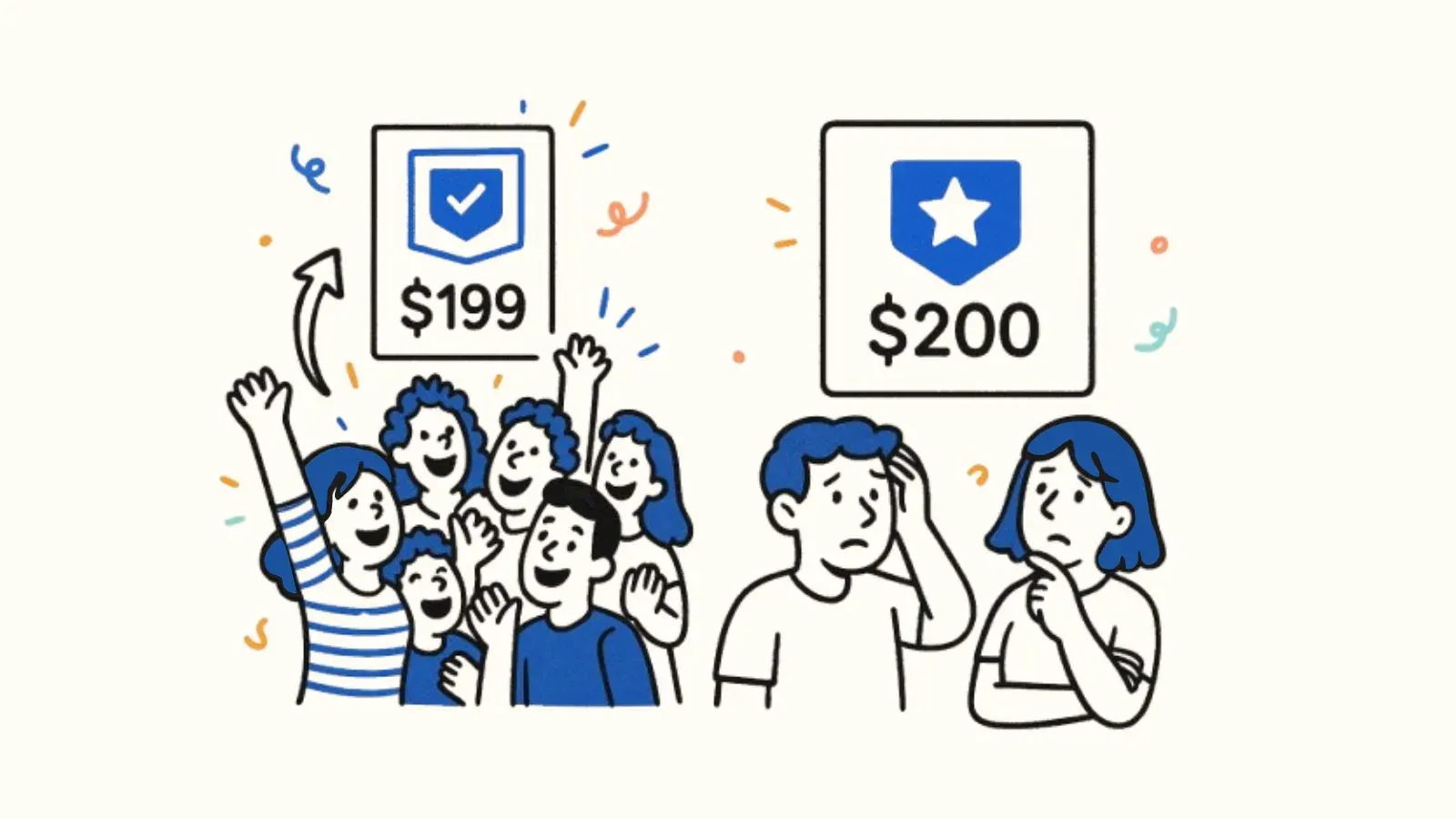
If you’ve ever wondered why your $200 course isn’t converting like your competitor’s $199 one, buckle up. This rabbit hole is deeper than you'd think.
TL;DR (For the Speed Readers & the Coffee-Deprived):
- $199 feels cheaper than $200 because our brains are lazy and easily tricked. (True story.)
- Charm pricing taps into "left-digit bias." Yes, that’s a thing.
- $199 says, "I'm a smart buy." $200 says, "I'm a commitment."
- This doesn't work everywhere. Premium course buyers might prefer the roundness of $2000 over $1997.
So, if you are looking for pricing hacks for course creators, you're at the right blog.
First, Let’s Talk About the Left Digit Bias (a.k.a. Why $199 Feels Like a Bargain)
Our brains, for all their power, are a little lazy when scanning numbers. We read left to right, and when the first digit drops from 2 to 1, even by a penny, it feels like a steal.
"Consumers perceive $199 as ‘one hundred something’ instead of ‘two hundred’." – Kaushik Basu, Economist
Think of it like this:
- $200 is the start of a new chapter.
- $199 is still clinging to the previous page.
In essence, $199 feels like it belongs in the same neighborhood as $150, while $200 moved to the richer part of town.
Real Talk: You’ve Been Played
The last time you bought something for $99.99, thinking you were saving money, you weren’t. You were just emotionally comforted by a number. Grocery stores do it. Apple does it. Your online course should do it too.
Unless...
When $200 Might Actually Be Smarter
We know, $199 is the cool kid. But sometimes, premium audiences want clean, powerful, no-nonsense pricing. Think $2500 vs $2497.
Example:
- A career coaching bootcamp tested $2497 vs $2500. The round $2500 version converted better. Why?
- It felt more authoritative. Like, “We don’t do cents. We do success.”
So if you're offering:
- Executive-level training
- Corporate upskilling packages
- Lifetime memberships
...you might want to put the .99s to rest and go full luxe.
Middle-of-the-Pack Courses: Where $199 Shines Brightest
This is where charm pricing earns its crown.
Let’s say you’re running a 6-week async design course. You’re not a household name (yet), but your value is solid. You’re not luxury—but you’re not Udemy-cheap either.
Price it at $199 instead of $200, and watch conversions climb. It feels intentional. Strategic. Just right.
Bonus tip: Want to push urgency? Use $197 for early bird, then move to $247 for regular. It still feels like a deal.
Side Note from a Burnt-Out Marketer: You can spend 3 hours tweaking your copy or simply change your price from $200 to $199 and get quicker results. Just saying.
Pricing Tricks That Pair Well With Charm Pricing
Like cheese and wine—but make it psychology:
- Anchoring: Show your $199 course next to a $499 one. Suddenly it’s a steal.
- Decoy Pricing: Introduce a mid-tier option just to make your favorite look better.
- The Rule of Three: Offer three plans. Most people pick the middle.
- Odd Number Endings: $197 or $183 feel more “calculated” and data-driven than $200.
Just remember: tricks only work when the course actually delivers.
The Hyperstack Effect: Pricing + Proof = 🔥
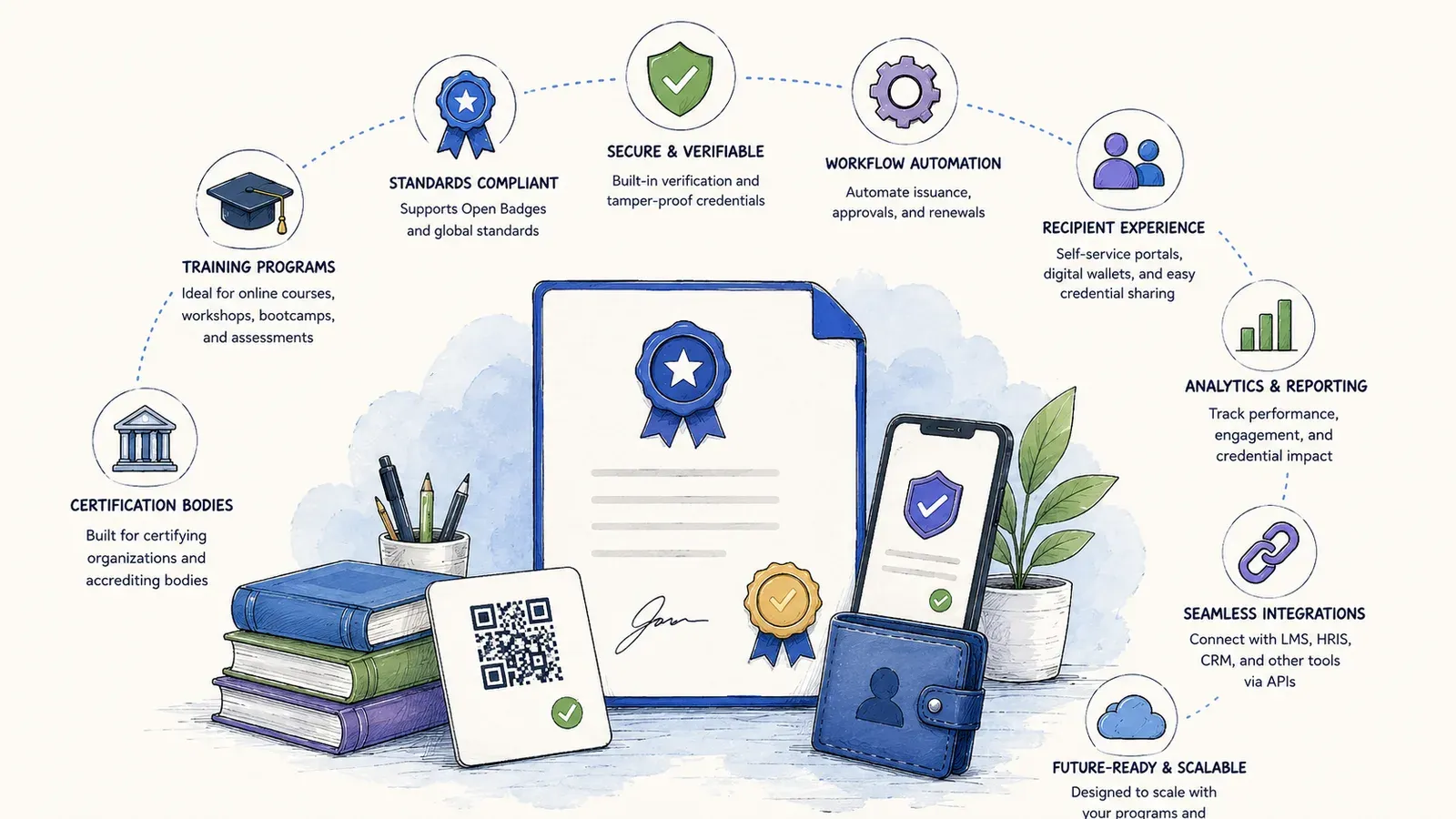
Let’s say you’ve nailed your price at $199. Want to 2x your perceived value? Give your learners a digital credential from Hyperstack.
- Completion badges for $199 courses = Instant legitimacy
- Stackable micro-credentials = Reason to charge $297 instead
- Learners share their badge? That’s free marketing, baby.
Read more: Digital Credentials in Education: Why They’re More Than Just Stickers
Quotes From the Trenches
"My $97 course flopped. Changed it to $99 and added a badge on completion. Sold out the next cohort." – Asha G., Indie Coach
"We priced our masterclass at $299. Dropped to $297 and added a credential. ROI? +22%." – Learning Studio founder (anon)
Not All Prices Are Created Equal
Here’s your rule of thumb:
- $199? Tells people you’re sharp.
- $200? Tells people you’re solid.
- $2497? Says you’re worth the investment.
- $19.95? Says "I’m affordable, but valuable."
What do you want your course to say?
FAQ: (Because You’ve Got Questions, And We’re Compulsive Problem-Solvers!)
Q: Isn’t charm pricing manipulative?
A: Not if your course delivers real value. Using psychology to reduce buyer hesitation isn’t a trick, it’s basically smart design. Hyperstack creators often use this in tandem with scarcity tactics to boost enrollments without losing trust.
Q: Does this work globally?
A: For the most part, yes. Even in markets like Asia, Europe etc. ₹999 feels better than ₹1000 and so does €9.99. But preferences vary. You’ve got to run small experiments to see what resonates within your ecosystem. Hyperstack's analytics can help you spot the sweet spot faster.
Q: What if I want to price at $200 flat?
A: Totally valid—especially if you’re positioned as premium. Just make sure your course, your certificate, and your onboarding flow reflect that quality. (Hint: A sleek Hyperstack credential helps)
Q: What’s the best charm number?
A: Classic ones like .99, .97, and .95 work well. But if you want to stand out, try .89 or even .77—just make sure it aligns with your brand voice and doesn’t look accidental.
Want to Learn More? Hidden Gems to Look Into:
- [Growing Your Online Course from 100 to 10,000 Learners]
- [Why Digital Credentials Are the Future of Modern Learning]
- [Digital Credentials in Education: Tools and Strategy for 2025]
- [Choosing the Best Digital Credential Management Platform for 2025]
- [Digital Credentials – A Complete Guide for 2025 And Beyond]
Certified Sources
- Left-Digit Bias Study by Sokolova, Seenivasan, Thomas (2020)
- MIT Sloan Study on Pricing Strategy in eCommerce
- Wine Price Experiment (Plassmann et al., 2008)
- MEG/EEG Price Incongruence Study, 2025
- Anchoring’s neural impact (Silberstein et al., 2015)
- Price Primacy Effect (Karmarkar et al., Harvard/Stanford)
- William Poundstone, Priceless: The Myth of Fair Value
And when you're done reading those; maybe check your course pricing one more time.
You know... just in case.
Tags
- Charm pricing
- Pricing psychology
- 199 vs 200
- Psychological pricing
- Pricing strategy for online courses
- How to price digital products
- Course pricing strategy
- Why 199 sells better
- Digital product pricing
- Consumer behavior pricing
- Online course pricing psychology
- Price perception in marketing
- Value based pricing strategy
- Behavioral economics pricing
- Sales conversion and pricing
- Creator economy pricing tips
- Best price for digital courses
- Does charm pricing still work
- Psychological tricks in pricing
- Pricing tactics for educators