Introduction: The Hidden Journey of Your Credential
We usually think of credentials as finish lines.
A course ends. A program concludes. A badge or certificate appears in your inbox.
Achievement captured. Goal complete. End of story.
Except, that is not how digital credentials behave in the real world.
A credential keeps moving long after you earn it. It circulates through networks, changes shape over time, and keeps influencing how others see your abilities. It has a life of its own.
And this is the story of that life. Where it goes, how it grows, what sustains it, and how it continues to represent you long after the moment of achievement.
Issuance: The Beginning of a Digital Record
When a credential is issued, it becomes a digital record backed by data.
A Record of Essential Information:
- The learner’s verified identity
- The issuer’s name and authority
- The skills or learning outcomes achieved
- Links or evidence that support the claim
- The date and context of completion
This data structure is known as metadata, and it gives the credential meaning beyond its visual badge.
A good credential is not just an image. It is a verifiable data object designed to remain readable and trustworthy over time.
The badge is what YOU see. The metadata is what the world READS.
From Issuer to Learner: The Credential’s First Move
Once a credential is issued, it moves from the issuer’s system to the learner’s possession. This moment determines its future.
Portability
If the credential is stored only inside one platform, it depends on that platform’s survival. If the platform shuts down, rebrands, or changes access rules, the credential’s verification may disappear. But if the credential follows open standards, it travels with the learner.
Learners can store it in wallets, portfolios, or public profiles. It can appear on:
- LinkedIn pages
- Hiring systems
- Online portfolios
- Educational applications
- Decentralized learning wallets
Portability keeps a credential alive.
Without it, credentials fade quietly in inboxes and archives.
Hyperstack’s design makes credentials portable, ensuring that learners own their achievements instead of simply accessing them through a dashboard.
The Mindshare Loop: Recognition That Grows Over Time
A credential gains strength through visibility.
The more it circulates, the more it reinforces recognition for both the learner and the issuer.
At Hyperstack, we call this the Mindshare Loop.
Here’s how it works:
- A credential is issued and shared publicly.
- Others see and trust it, connecting the skill to both learner and issuer.
- That trust reinforces recognition.
- Future credentials from the same issuer become easier to believe in.
- The cycle repeats, creating a self-replicating loop of shared trust.
Each share, verification, or mention strengthens this loop.
It is not just about one-dimensional marketing; it is about visibility turning into a collective memory.
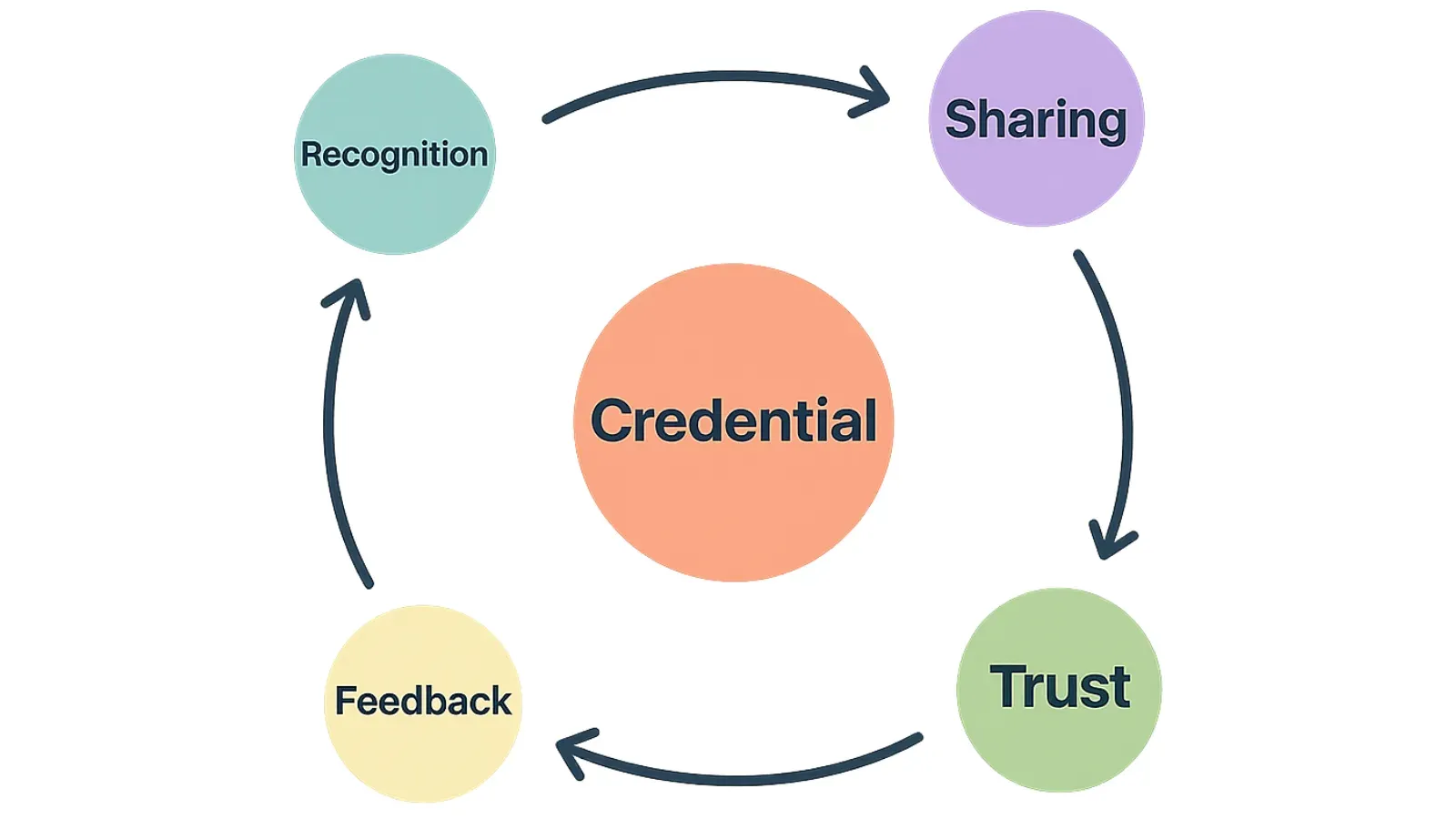
The Mindshare Loop is why some credentials gain lasting presence while others quietly fade.
Visibility creates memory. Memory builds value.
The more your credential is seen, the more its truth is assumed
Metadata and Meaning: The Invisible Foundation
Metadata is the quiet engine behind every digital credential.
It tells systems what the credential means, who issued it, and how it can be verified.
Without metadata, a badge is just a picture.
Strong metadata ensures:
- Accurate verification
- Consistent formatting across platforms
- Compatibility with evolving standards
- Clarity about what was actually achieved
Metadata gives a credential structure and context.
It allows it to survive software updates, new standards, and institutional changes.
Hyperstack credentials follow the Open Badges standard, which guarantees interoperability across global systems.
What’s an Open Badge?
An Open Badge is more than a digital sticker; it’s a verified proof of skill, achievement, or participation that travels with you anywhere online. Built on the Open Badges Specification, these badges carry embedded metadata that tells the full story: who earned it, who issued it, what it represents, and the evidence behind it.
Each badge pairs a visual symbol with verifiable data, making it both recognizable and reliable. They can appear on your CV, LinkedIn profile, or personal portfolio—essentially, anywhere you want to showcase what you’ve accomplished. From universities and nonprofits to global employers, thousands of organizations now issue Open Badges to recognize learning and achievement in a digital-first world.
What Do Open Badges Represent?
An Open Badge can signify just about any kind of verified achievement:
- A hard skill, like coding in Python.
- A soft skill, like teamwork or leadership.
- Participation in a program or community.
- Official certifications or authorizations.
- Or even emerging literacies that traditional systems overlook.
Because Open Badges follow a shared, open standard, learners can collect badges from multiple issuers such as universities, employers, and online platforms, and build a cohesive, verified profile of their learning journey.
These badges aren’t static icons; they’re living records of growth. They can be shared anywhere, used for career advancement, education, or simply lifelong learning.
Why They Matter
Anyone can issue, earn, or verify an Open Badge. The transparency of its metadata allows anyone to inspect the evidence behind the achievement, ensuring trust. Issuers can also validate that their badges are compliant and interoperable across platforms, from digital wallets to credential display tools.
At their core, Open Badges help people set goals, showcase progress, and connect experiences across formal and informal learning environments.
They turn achievements, big or small, into visible, verifiable proof of growth that speaks for itself.
That means a Hyperstack credential can remain valid even if the ecosystem around it changes.
Time and Relevance: How Credentials Age
Time changes the meaning of credentials.
Some gain weight and credibility as years pass. Others lose relevance as skills evolve.
For example:
- A foundational degree remains valid indefinitely.
- A software certification may need renewal after updates.
- A compliance course might expire when regulations change.
There is no single lifespan for a digital credential and it's relevance depends on the nature of what it represents.
This is why Hyperstack lets issuers decide whether a credential should expire or remain permanent.
Some achievements are timeless. Others must evolve.
Credential expiration is not about limitation. It is about maintaining truth.
The Reputation Singularity: When Proof Becomes Identity
At a certain point, your credentials begin to merge into something larger than individual achievements.
They start forming your reputation signature: the way people recognize your abilities without needing to verify every detail.
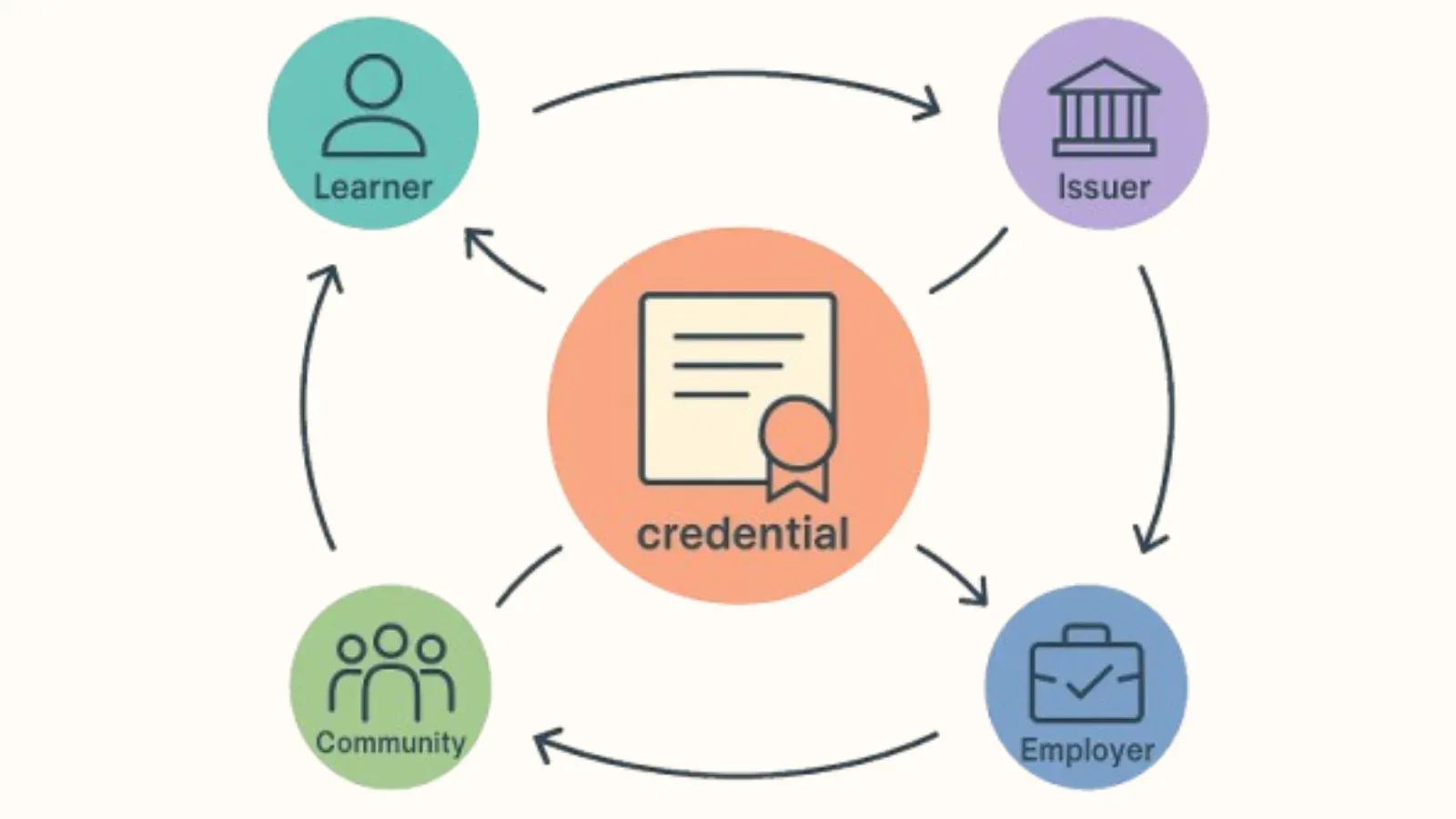
Hyperstack calls this convergence the Reputation Singularity.
This happens when:
- Verification is no longer requested because your identity already carries credibility
- Your credentials tell a consistent story about your expertise
- The issuer’s reputation and your reputation reinforce one another
- The credential itself becomes shorthand for trust
When someone sees your name and recalls your verified achievements without even checking a link, that is the Reputation Singularity at work.
This is the natural evolution of recognition in the digital age: Proof that embodies your brand presence.
When Credentials Lose Their Memory
Not every credential reaches longevity.
Digital systems are not immune to decay.
Over time:
- Links expire
- Metadata becomes outdated
- Institutions merge or dissolve
- Evidence pages disappear
The result is what we call a ghost credential; something that exists visually but cannot be verified.
It looks real, but its proof has vanished.
This happens not because learning was invalid, but because the infrastructure behind it aged poorly.
Hyperstack protects against this by maintaining independent verification endpoints.
Even if a program changes, the learner can still prove authenticity.
Ownership ensures longevity but dependence shortens it.
Institutions as Stewards of Learning Memory
Issuers hold an important role beyond creating credentials.
They must also maintain them as part of learning heritage.
Here’s what responsible stewardship looks like:
- Maintain Verification Systems
Credentials must stay verifiable, even years after issuance.
- Update Standards
Keep metadata aligned with current formats to avoid future compatibility issues.
- Ensure Learner Access
Provide export tools so learners can store credentials independently.
- Archive with Intention
Even discontinued programs deserve preserved records.
- Manage Revocation Responsibly
Only revoke when absolutely necessary and maintain transparency about why.
When institutions treat credentials as heritage, not just products, they strengthen trust in their ecosystem.
The Learner’s Role: Owning and Preserving Proof
Learners, too, play a role in the life of a credential.
Ownership does not stop at download.
Here are best practices for learners:
- Save multiple copies: Always download credentials for offline backup.
- Use interoperable wallets: Avoid tools that lock data behind paywalls.
- Keep evidence live: Ensure linked portfolios or proof pages stay accessible.
- Review metadata periodically: Update outdated contact or institutional info.
- Display selectively: Highlight credentials that build a clear narrative of your growth.
A credential’s endurance depends on how actively you preserve it.
Learning deserves guardianship, not just celebration.
The Mindshare Loop in Action
Imagine two learners with identical credentials. Both post their badges online.
One shares it publicly, engages with comments, and links it to a live project. The other stores it quietly in a digital folder.
Six months later, the first credential starts appearing in recruiter searches and internal talent systems.
The second is almost invisible.
The difference is the Mindshare Loop.
Every interaction, share, and reference adds weight to a credential’s reputation.
Hyperstack supports this natural loop by making credentials discoverable, verifiable, and shareable across multiple platforms.
Recognition cannot grow in silence.
The Reputation Singularity at Scale
As credentialing systems grow, millions of verified achievements begin forming shared reputations.
A network of trust emerges between institutions, learners, and verifiers.
This is the Reputation Singularity on a global level: a space where digital identity, skill verification, and reputation merge into a transparent ecosystem.
In this ecosystem:
- Learning becomes part of lifelong identity.
- Skills remain traceable across careers and industries.
- Institutions gain collective credibility through verified alumni.
Hyperstack’s framework supports this shift by keeping data portable, interoperable, and learner-owned.
Because recognition should never depend on a single platform’s lifespan.
The Future of Digital Credential Lifecycles
The next evolution of credentials will not focus on design or delivery.
It will focus on continuity, ensuring that learning records remain alive and verifiable even decades from now.
We will see credentials that:
- Automatically update when standards evolve
- Link directly to living evidence (not static screenshots)
- Contribute to AI-based talent and skills graphs
- Bridge academic, professional, and lifelong learning records
Hyperstack’s commitment to open standards positions it at the center of this future.
Because technology will change, but the principle remains: learning deserves permanence.
Conclusion: The Life That Continues
A credential is not the end of learning. It's a continuing relationship between recognition and identity.
It lives in systems, in data, and in the minds of others who recognize it.
It gains or loses visibility based on how it is preserved. It becomes part of reputation, part of heritage, part of who we are remembered to be.
The life of a credential begins at issuance but it continues every time someone verifies, trusts, or remembers it.
Your learning should live that long.
So, why wait? Schedule a free demo today!
Frequently asked questions
Once issued, a digital credential becomes a verified data record that represents your achievement. It can be stored in your digital wallet, shared on professional platforms such as LinkedIn, or verified by employers and institutions. If it follows open standards like Open Badges , it continues to exist independently of the original issuing platform.
Yes. Some credentials are permanent, while others are designed to expire after a certain period, especially if they represent time-sensitive skills such as compliance or technology certifications. Many issuing platforms allow organizations to define expiration dates or renewal requirements based on the type of achievement.
Digital credentials include a verification link or QR code that connects to the issuer’s verification endpoint. This link confirms the credential’s authenticity and provides details such as the issue date, skills achieved, and institution identity. Verification ensures the record is tamper-proof and traceable to its original source.
A credential’s life cycle begins at issuance and continues through sharing, verification, recognition, and long-term storage. Over time, it contributes to your professional visibility and becomes part of your digital identity. When multiple verified records accumulate, they begin shaping your reputation and trustworthiness in the learning ecosystem.
Metadata is the information inside your credential that defines what it represents, who issued it, and why it is valid. It gives the credential meaning beyond its visual appearance. Properly structured metadata keeps credentials portable, verifiable, and readable even as technology evolves.
If your credential was created using open standards, it remains accessible and verifiable even if the issuing platform changes or closes. Open formats ensure you can export, store, and present your credential without relying on a single vendor.
Yes. Digital credential wallets allow you to collect, organize, and share all your verified achievements from different issuers. Storing them in one place makes it easier to manage your learning history and share your credentials securely when needed.
A digital badge usually represents specific skills or micro-achievements. A digital certificate covers broader qualifications, such as completing a full course or program. Both are verified credentials, differing mainly in scope and context. For a better understanding check out our blog titled "Badges vs Certificates"
Digital credentials can be displayed directly on your professional profiles or personal websites. Each time they are viewed, verified, or referenced, they strengthen your visibility within professional and learning communities. This process of recognition reinforcing recognition is sometimes called the Mindshare Loop .
If you do not download or back them up, you might lose access when a platform changes or deactivates accounts. Always export your credentials in standard formats and store them safely so they remain under your control.
Tags
- Digital credential lifecycle
- Credential ownership
- Credential permanence
- Credential verification
- Digital learning identity
- Metadata integrity
- Open badges standard
- Credential expiry
- Reputation singularity
- Mindshare loop
- Credential portability
- Learner controlled credentials
- Credential stewardship
- Data ownership learning
- Credential afterlife
- Credential metadata
- Lifelong learning identity
- Open badge verification
- Digital heritage
- Credential revocation
- Skill recognition
- Learning ecosystem