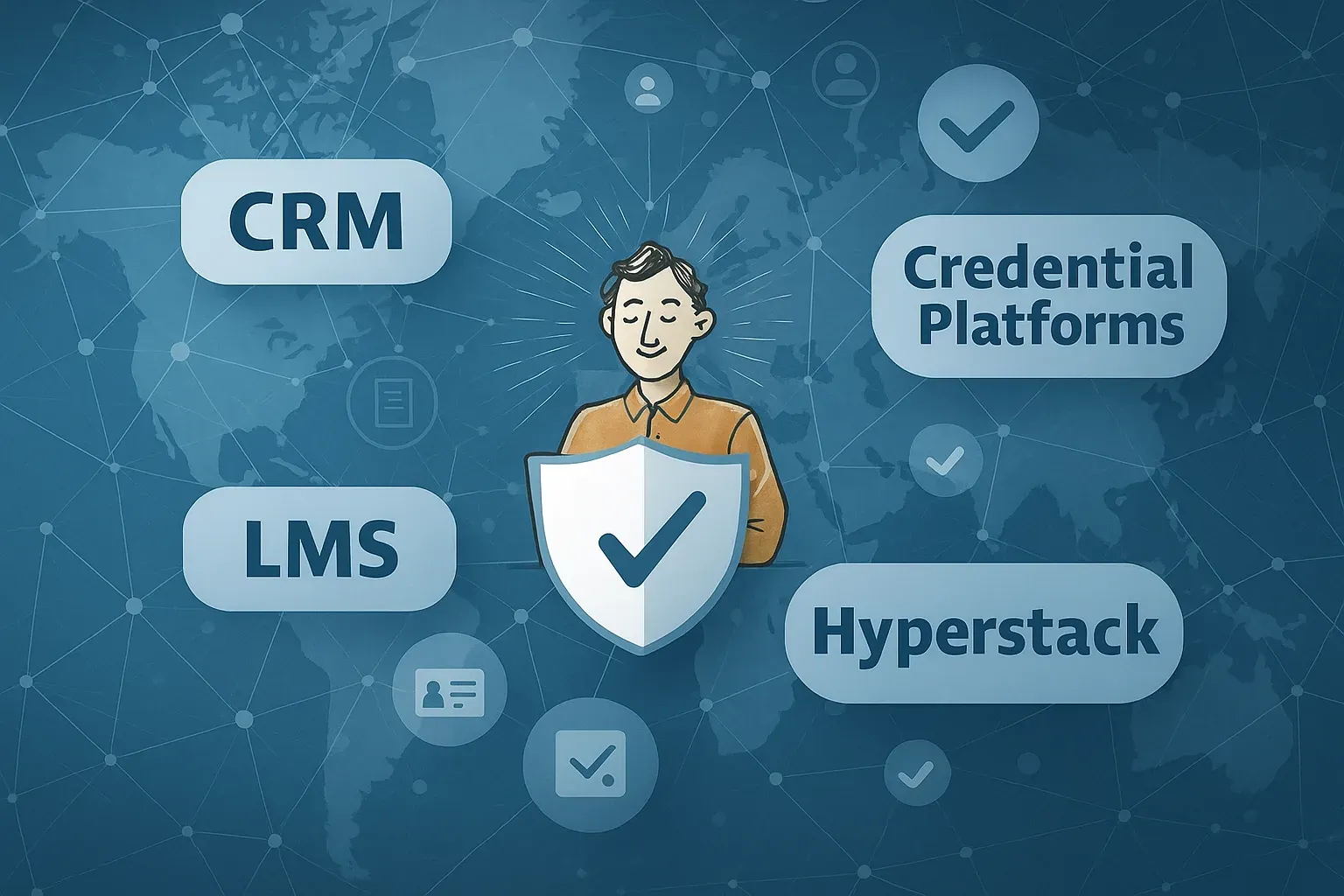
If you’ve ever tried to introduce two friends who “should totally get along” but end up talking past each other, you already understand the state of digital credentials. Your LMS is over here handing out cheerful gold stars. Your CRM is over there, quietly hoarding alumni and employer data. And your credentialing platform is waving frantically in the middle, trying to translate it all into something employers can actually recognize.
When these systems don’t talk, learners end up with shiny but stranded badges. When they do, credentials transform into living, portable assets that boost careers, improve employer trust, and drive institutional growth.
This is where interoperability steps in. It ensures that your LMS, your CRM, and your credentialing platform are less like awkward acquaintances and more like a synchronized relay team. And if you’re wondering what this looks like in practice, platforms like Hyperstack are showing how credentials can move seamlessly across systems, without losing their value or authenticity.
Why Interoperability Matters in 2025
Think of your digital learning ecosystem as a dinner party. The LMS is the host, the CRM is the guest list manager, and the credentialing platform is the photographer capturing proof that everyone showed up. If they don’t talk to each other, chaos ensues: guests show up uninvited, photos never make it into the album, and the host has no idea who ate all the cake.
Interoperability ensures these systems collaborate, creating a seamless learner experience while preserving trust, portability, and verification. Without it, credentials risk becoming just pretty stickers instead of currency learners can spend in the real world.
What Does “Interoperability” Actually Mean?
In plain terms, interoperability is the ability of systems to exchange data and actually make sense of it. For digital credentials, this involves several layers of functionality.
First, there is data portability, which ensures a learner’s achievements can move between LMS, CRM, and credentialing platforms. Then there is verification, which allows employers to check authenticity without endless back-and-forth. Scalability is equally important, since thousands or even millions of credentials may need to be issued, shared, and recognized without the system breaking down. Finally, there is security, which ensures sensitive learner data is not lost in translation.
Without interoperability, institutions fall into silos. The LMS issues badges no one outside can verify, the CRM tracks engagement without knowing achievements, and the credentialing platform issues credentials disconnected from learner progress.
Hyperstack solves this fragmentation by connecting directly with LMSs and CRMs, ensuring credentials travel smoothly across the entire learning journey. Take a look for yourself.
LMS and Digital Credential Platforms: Friends or Frenemies?
Most LMSs, including Canvas, Blackboard, Moodle, and TalentLMS, now include badge-issuing features. These badges are motivating, even fun, and they keep learners engaged. But their usefulness tends to stop the moment a course ends. Outside the LMS, those badges carry little weight.
Credentialing platforms such as Hyperstack, Credly, or Sertifier take the process further. They issue credentials that are portable, verifiable, and stackable, embedding metadata that proves what the learner has achieved. These credentials function less like stickers and more like passports, opening doors beyond the LMS.
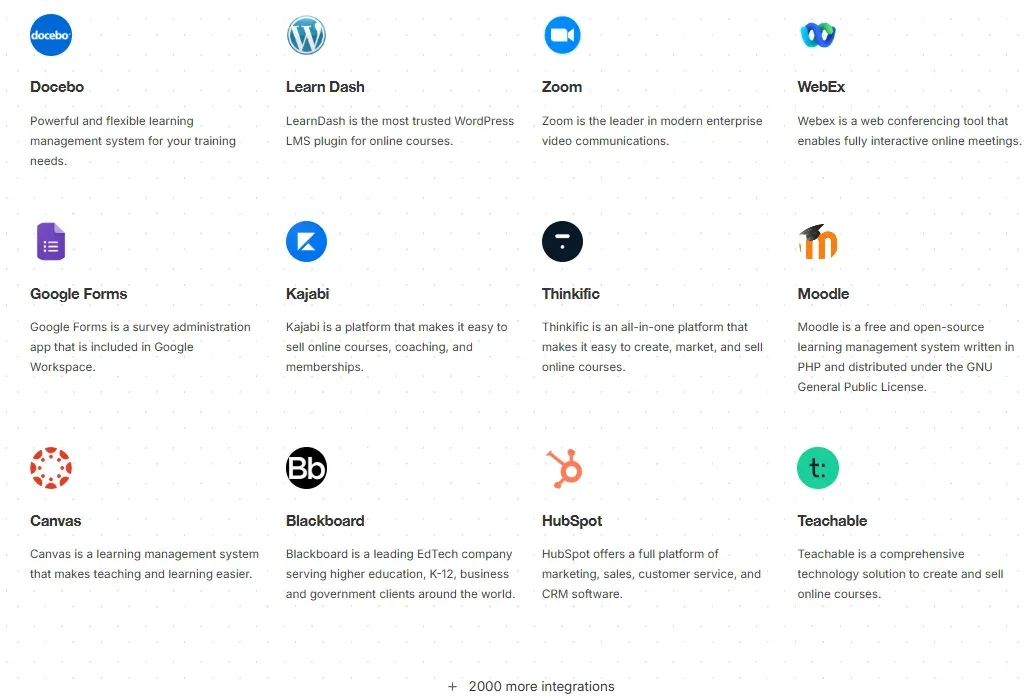
Here are some of the 2000+ LMS platforms you can now integrate via Hyperstack.
Now, a further tension lies in how these systems overlap. LMS badges inspire learners during the course, but they rarely travel. Credentialing platforms create durable credentials, but they need LMS data to make them meaningful.
Interoperability bridges this gap by ensuring, for instance, that a badge earned in Canvas can automatically become a verifiable credential in Hyperstack. Learners stay motivated while studying and walk away with proof they can use in the workplace.
CRM Systems and Credentials: The Missing Link
CRMs like Salesforce, HubSpot, or Zoho are often overlooked in credentialing discussions, but they are where the most important relationships live.
An alumni CRM could track every credential a graduate has earned, making it easy to engage them with advanced programs.
A corporate CRM could connect employee training credentials to retention data and career advancement. Employers could use CRM-linked credentials to accelerate skill matching.
When CRMs are disconnected, institutions miss out on a goldmine of strategic insights. With interoperability, credentials do more than verify skills. They fuel alumni engagement, corporate partnerships, and institutional growth.
Hyperstack already supports CRM integrations, creating unified records of achievement that add strategic value well beyond course completion.
Blockchain and Open Badges 3.0: The Trust Layer
Open Badges 3.0: A Shared Language for Credentials
Open Badges 3.0 is not just a prettier badge. It is a specification that ensures every digital credential carries portable, standardized metadata: the issuer, the date, the criteria, and often links to evidence. With this consistency, credentials issued on one platform can be read and verified on another, whether that’s an LMS, a CRM, or a credentialing platform like Hyperstack.
Think of it as teaching every credential to speak the same language. Without it, systems can talk past each other. With it, credentials move fluidly across institutions and borders, becoming part of an interoperable credentialing system. Open Badges 3.0 also aligns with W3C’s Verifiable Credentials model, which makes cross-platform exchange even smoother.
Blockchain: Tamper-Proofing and Trust
Where Open Badges 3.0 ensures shared meaning, blockchain ensures integrity. By recording credentials on a blockchain, institutions can make them tamper-proof. If someone tries to alter the record, it becomes immediately obvious. Employers and verifiers can check authenticity without relying on trust alone.
This layer is not just theoretical. In fields like healthcare, finance, or compliance-heavy industries, blockchain-backed credentials give peace of mind that a qualification is exactly what it claims to be. Platforms such as Hyperstack use blockchain to make credentials not only portable but also resistant to fraud.
Why the Combination Matters
Open Badges 3.0 gives credentials a universal structure. Blockchain gives them a seal of authenticity. Together, they turn what might otherwise be a digital sticker into something employers and institutions can trust worldwide.
That means a learner’s credential is not just visible, it is verifiable at scale. It is recognized across LMSs, CRMs, and global ecosystems, and it holds up under scrutiny. For institutions, this combination is less about chasing trends and more about building a foundation of credential verification at scale that will stand the test of time.
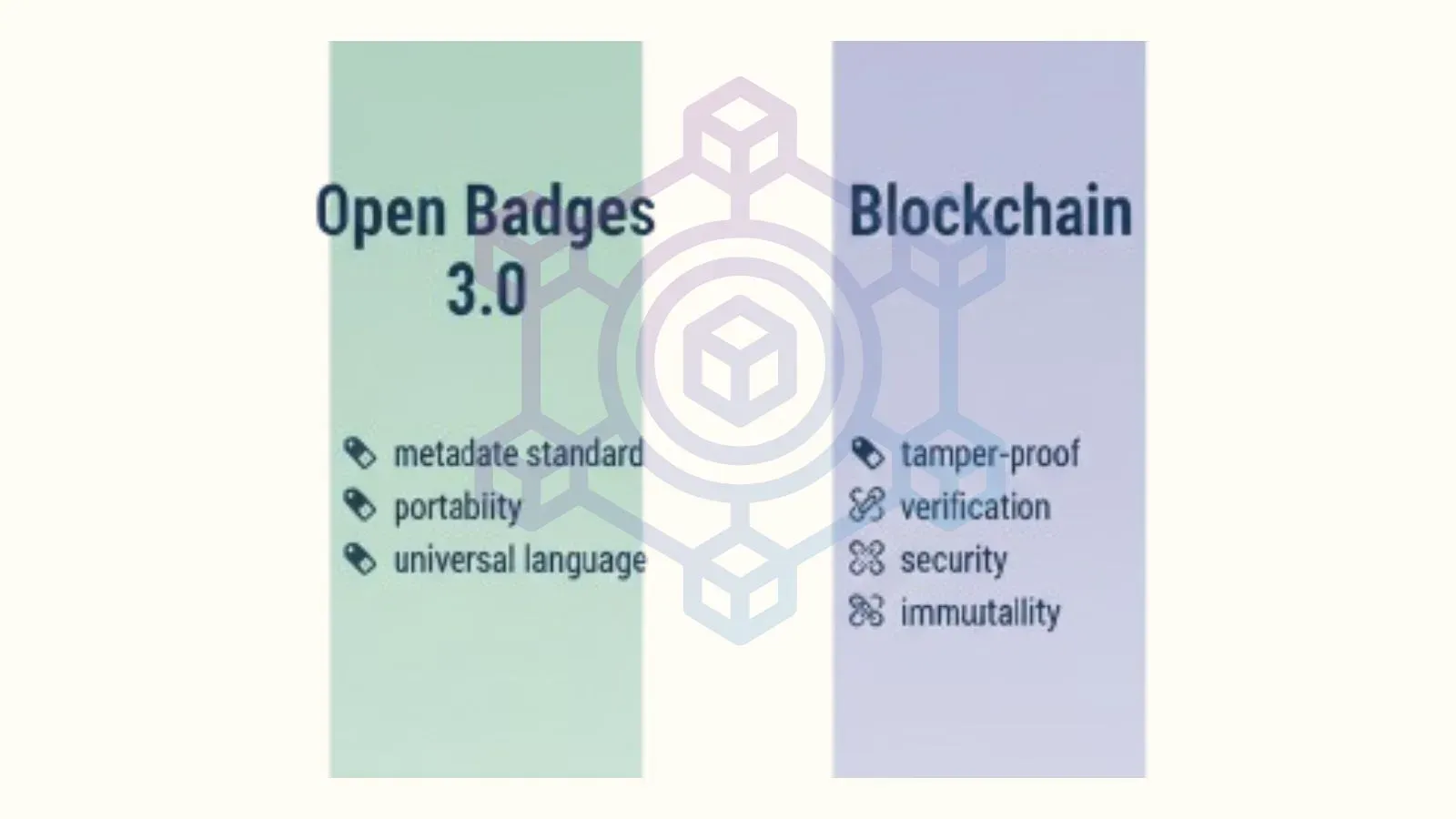
Open Badges 3.0 provides the common framework. It ensures that every credential carries portable metadata, regardless of where it was issued. Without it, credentials would be like dialects no one else understands. With it, they move freely between LMSs, CRMs, and platforms like Hyperstack.
Blockchain adds the trust. By recording credentials on a blockchain, institutions can guarantee they are tamper-proof. For industries such as healthcare, finance, or compliance training, this is not optional, it is essential.
Hyperstack supports blockchain-backed credentialing, enabling organizations to issue secure achievements employers can verify instantly.
Together, these technologies ensure credentials aren’t just pretty images but universally trusted and portable proof of learning.
How Credentials Travel Across Systems
A learner starts in the LMS, where badges keep them motivated during the course. Once complete, Hyperstack converts those badges into verifiable credentials enriched with metadata.
The institution’s CRM then tracks these achievements, helping alumni teams re-engage graduates and corporate partners measure ROI on training programs.
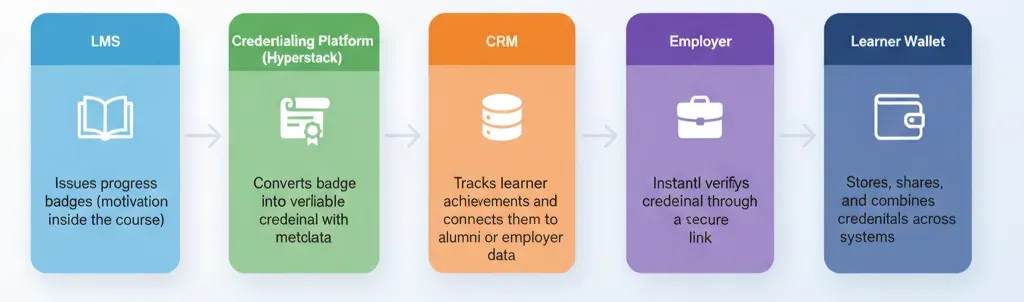
Employers receive a credential link they can verify in seconds. Finally, learners store all of this in their personal digital wallet, combining achievements from different sources into a single, portable identity.
When every system communicates, credentials become more than records. They become active bridges connecting learners, institutions, and employers.
The Business Case: Interoperability as an ROI Multiplier
When systems remain siloed, institutions lose trust, satisfaction, and efficiency. Employers hesitate to believe unverified credentials. Learners feel frustrated when achievements cannot travel outside the course. Staff waste time manually validating records.
When systems interoperate, the picture shifts entirely. Institutions can issue millions of credentials without bottlenecks. They gain analytics that map learner skills against workforce needs. They keep alumni engaged by ensuring their achievements are visible and valuable long after graduation.
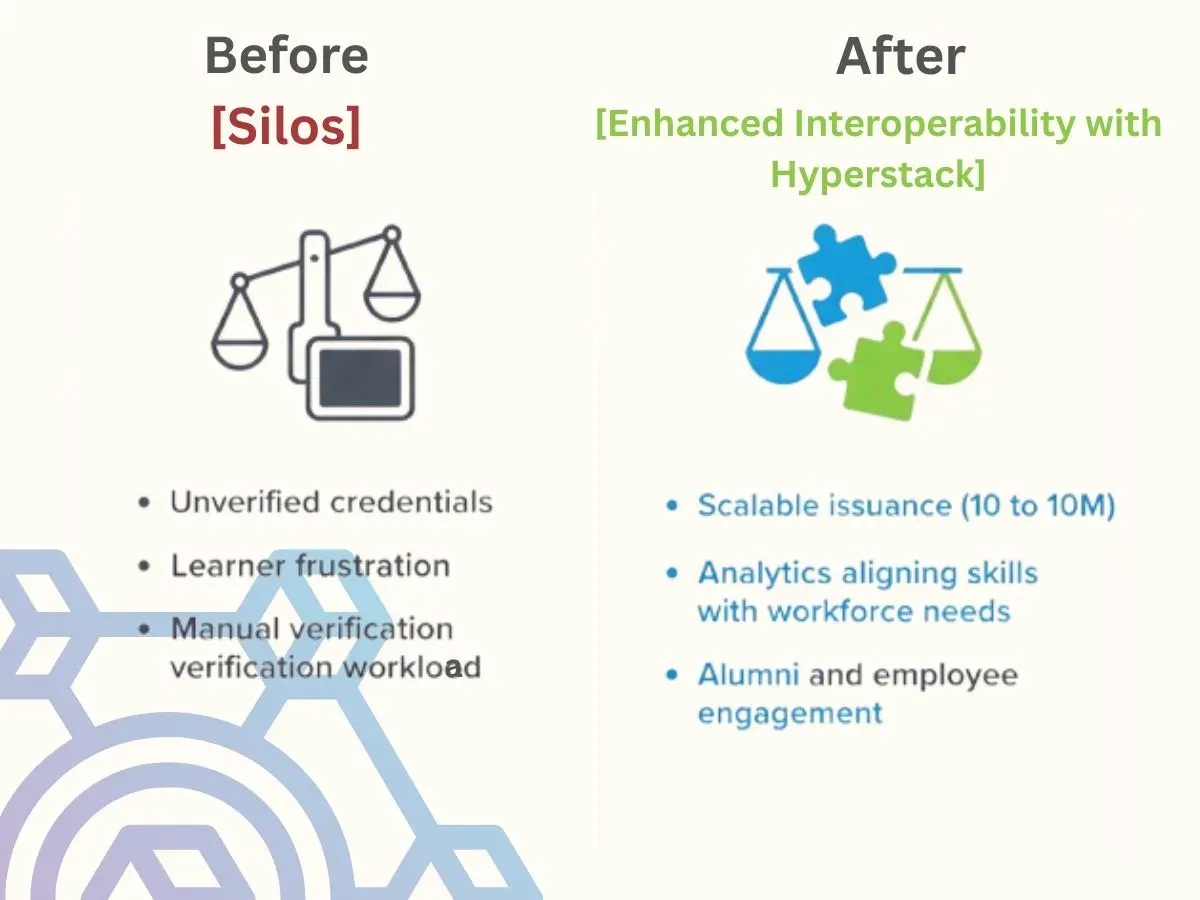
Hyperstack has been designed with an API-first approach that allows it to integrate flexibly with LMSs, CRMs, and enterprise systems. This makes interoperability more than a technical win. It becomes a strategic driver for revenue, retention, and reputation.
How to Build an Interoperable Credential Ecosystem
To create an ecosystem where credentials truly move, institutions should start by adopting standards such as Open Badges 3.0. Blockchain verification adds a critical layer of security. APIs are the lifeline, ensuring that LMSs, CRMs, and credentialing platforms can talk without friction.
Credentials themselves should be designed as stackable pathways that grow with learners.
And finally, learners must have access to digital wallets so they can own, manage, and share their credentials across contexts. Hyperstack supports all these elements, helping institutions future-proof their credentialing strategies.
Closing Thought
Interoperability in 2025 is like electricity. When it flows, no one notices. When it fails, everything stops. Institutions that continue treating LMSs, CRMs, and credentialing platforms as isolated silos will be left with credentials that look impressive but carry little weight.
Those that embrace interoperability will empower learners with credentials that travel, employers with trust they can rely on, and themselves with insights that drive growth.
Frequently asked questions
Most LMSs provide simple badges, but only a few experiment with blockchain verification. Institutions typically rely on integrations with credentialing platforms like Hyperstack to give learners portable, verifiable credentials.
Open Badges 3.0 standardizes credentials, enabling them to move seamlessly between LMSs, CRMs, and credentialing platforms. Without it, systems would remain siloed. Have a look at our two cents on everything Open Badges, here.
Yes. Hyperstack integrates with CRMs to create unified achievement records. This supports alumni engagement, corporate partnerships, and ROI measurement.
Blockchain makes credentials tamper-proof and verifiable at scale. Employers can confirm authenticity instantly, removing reliance on manual trust. Read more about this in our blog series , for in-depth insights and updates.
Yes. LMS badges provide motivation inside courses, while platforms like Hyperstack issue portable, verifiable credentials that add external value. Together, they form a balanced and effective system.
Tags
- Digital credential interoperability
- LMS and credentialing integration
- CRM and digital credentials
- Open badges 3 0 interoperability
- Blockchain based credentials
- Digital credential ecosystems
- Credential verification at scale
- API integration for credentials
- Stackable micro credentials
- Digital learner identity
- Credential portability
- LMS vs credentialing platforms
- Enterprise credentialing solutions
- Interoperable credentialing systems
- Lifelong learner digital wallet